The Cyrus Cylinder
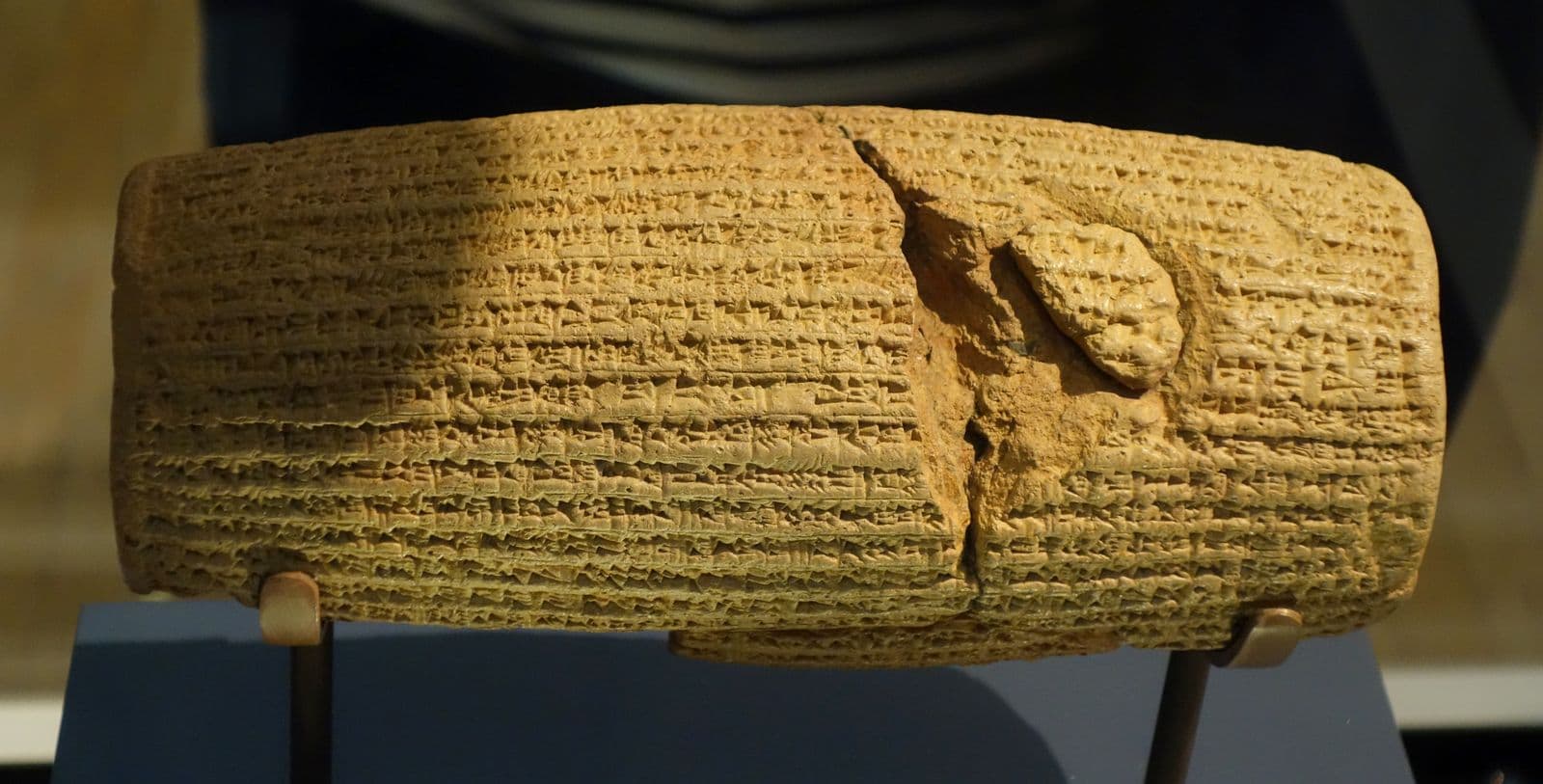
The object routinely called the world's first charter of human rights is a standard Mesopotamian foundation text. In it a new king announces that the god Marduk went looking for a righteous ruler, chose him, and that he has since put the temples back in order. The human-rights reading was attached to it by the Shah of Iran in the late 1960s and sold to the world in 1971, at an anniversary party.
Found: Amran mound, Babylon, Iraq (the Esagila area), from Hormuzd Rassam's 1879 excavation; British Museum 90920 (1880,0617.1941).
What it says
A barrel-shaped cylinder of fired clay about 22 centimetres long, written in Babylonian cuneiform and made to be buried in the foundations of a building, which is what cylinders like this were for. It was written after Cyrus took Babylon in 539 BC, and it is a foundation document of an entirely conventional kind: the previous king neglected the gods, Marduk searched the lands for a righteous ruler and found Cyrus, Cyrus entered the city without a battle, and Cyrus has restored the temples and sent the gods deported to Babylon back to their own shrines.
Every move in that sequence is a move Babylonian kings had been making in writing for a thousand years. It is a new ruler telling a conquered city that its own god preferred him.
Where the other reading came from
Not from the clay. The Shah's government was calling it the first declaration of human rights by 1968; in 1971 it made the cylinder the emblem of the 2,500th-anniversary celebrations, and on 14 October that year the Shah's sister handed a replica to the UN Secretary-General. The phrase stuck, and it is still the first thing most people are told about the object.
There is nothing in the text about rights. The returns it describes are of the gods' statues to their shrines, and of the people of those cities to their settlements, ordered by a king restoring the religious arrangements his predecessor had disturbed — generous, politically shrewd, and not a declaration of anything.
Why this card says Legend
The badge is on the fame, not the object. The cylinder is genuine, it was excavated, and it has been published and translated for nearly a century and a half. What is legendary is the story told about it, and that story dates from the Shah's Iran, not from 539 BC. Both facts stay on the one card, because dropping either of them is where the lie would be.
- Finkel (ed.), The Cyrus Cylinder: The King of Persia's Proclamation from Ancient Babylon (2013)
- Kuhrt, 'The Cyrus Cylinder and Achaemenid Imperial Policy', JSOT 25 (1983), 83–97
- Schaudig, Die Inschriften Nabonids von Babylon und Kyros' des Großen (2001)
- British Museum 1880,0617.1941, collection record with Irving Finkel's translation
- Rawlinson, 'Notes on a newly-discovered Clay Cylinder of Cyrus the Great', JRAS n.s. 12 (1880), 70–97: first publication
- Kuhrt, The Persian Empire: A Corpus of Sources (2007), ch. 3 no. 21: accessible translation
- Photograph: Daderot, 2024, CC0 (via Wikimedia Commons). Object: British Museum, London, 90920. Licence verified 2026-09-22.
