A wax tablet from Roman London
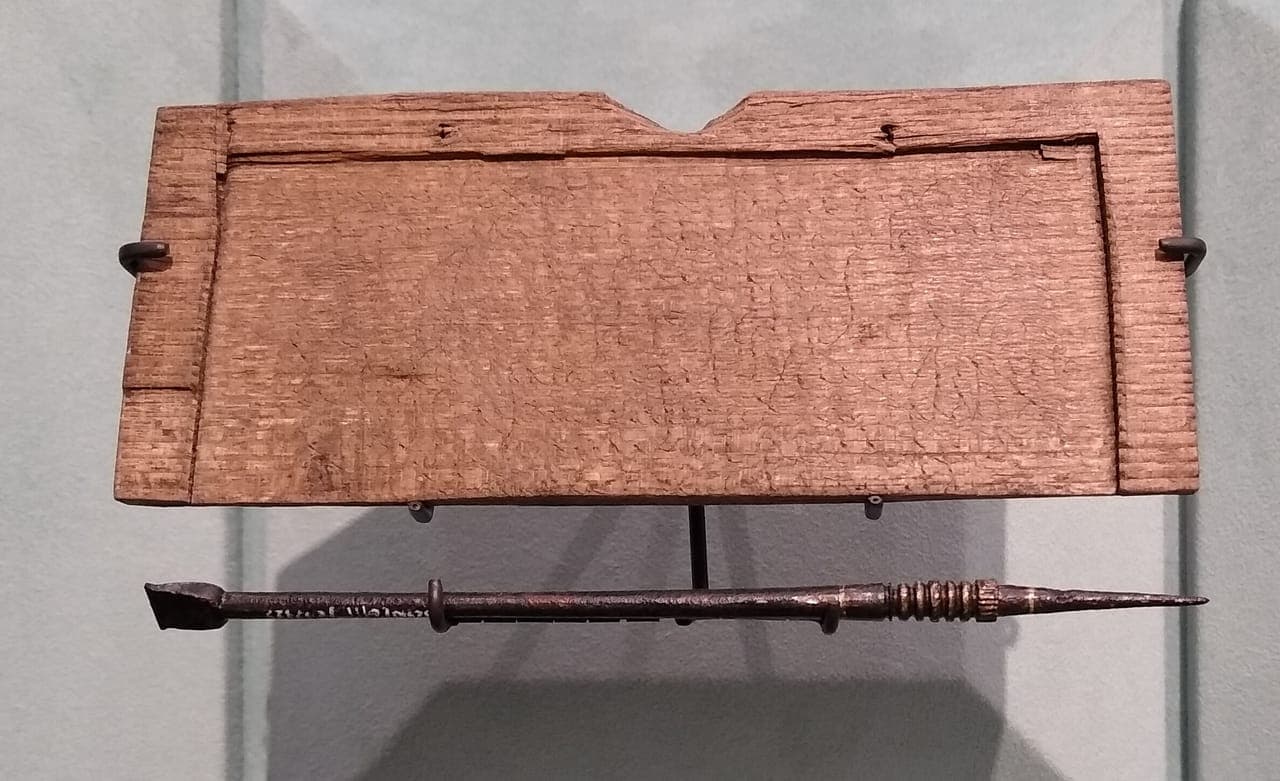
The earliest dated handwritten document known from Britain is an IOU. On 8 January AD 57, a freed slave called Tibullus wrote that he owed 105 denarii for goods. He wrote it in black wax, which is long gone, but his stylus cut through into the wood beneath, and the scratches can still be read.
Based on Tibullus's tablet (WT44) where it survives, and other tablets and styluses from the same dig for the rest.
Found: the Walbrook, City of London, under today's Bloomberg building; excavated by MOLA, 2010–14.
How it worked
A thin board of silver fir, a tree that did not grow in Roman Britain, with one face hollowed out and filled with beeswax blackened with soot. You wrote with the sharp end of an iron stylus and rubbed words out with its flat end: "often turn your stylus," Horace told writers. Boards like this were hinged in pairs, wax facing in, by loops through the two small holes beside the notch. The Romans called boards bound together a codex, a "block of wood". The word stayed with the book.
Reading a tablet with no wax
The wax is gone. But where Tibullus pressed hardest, his stylus cut into the wood, and the letters survive as faint scratches, the upright strokes best. Only the top of the board survives; the note breaks off in its eighth line.
It is dated the Roman way, by the year's two consuls, Nero and Lucius Piso: AD 57, a year in which, Tacitus wrote, little worth remembering happened. The day is three worn strokes, read as VI by Roger Tomlin, who deciphered the tablets: six days before the Ides of January, counting the Ides itself, is 8 January.
- Tomlin, Roman London's First Voices: Writing Tablets from the Bloomberg Excavations, 2010–14 (MOLA Monograph 72, 2016), tablet WT44: the edition
- Roman Inscriptions of Britain online, Tab.Lond.Bloomberg 44 (Tomlin's text, translation and notes) and 'The tablets: their form and epigraphy'
- Horace, Satires 1.10.72 ('often turn your stylus'), and Tacitus, Annals 13.31.1 (the year of Nero and Piso)
- Seneca, On the Shortness of Life 13.4, and Varro in Nonius 535 M: codex, boards joined together
- Picture: rendered from our own 3D model, the one on the workbench: a reconstruction, not a record of how it looked.
- Photograph: Mx. Granger, 2020, CC0 (via Wikimedia Commons). Object: London Museum, London. Licence verified 2026-09-30.
