A letter in a clay envelope
He ran out of room. The merchant filled every side of a tablet about the size of a matchbox, then shaped a second, tiny tablet to finish his sentence, and sealed both inside one clay envelope. To read it, you had to break it.
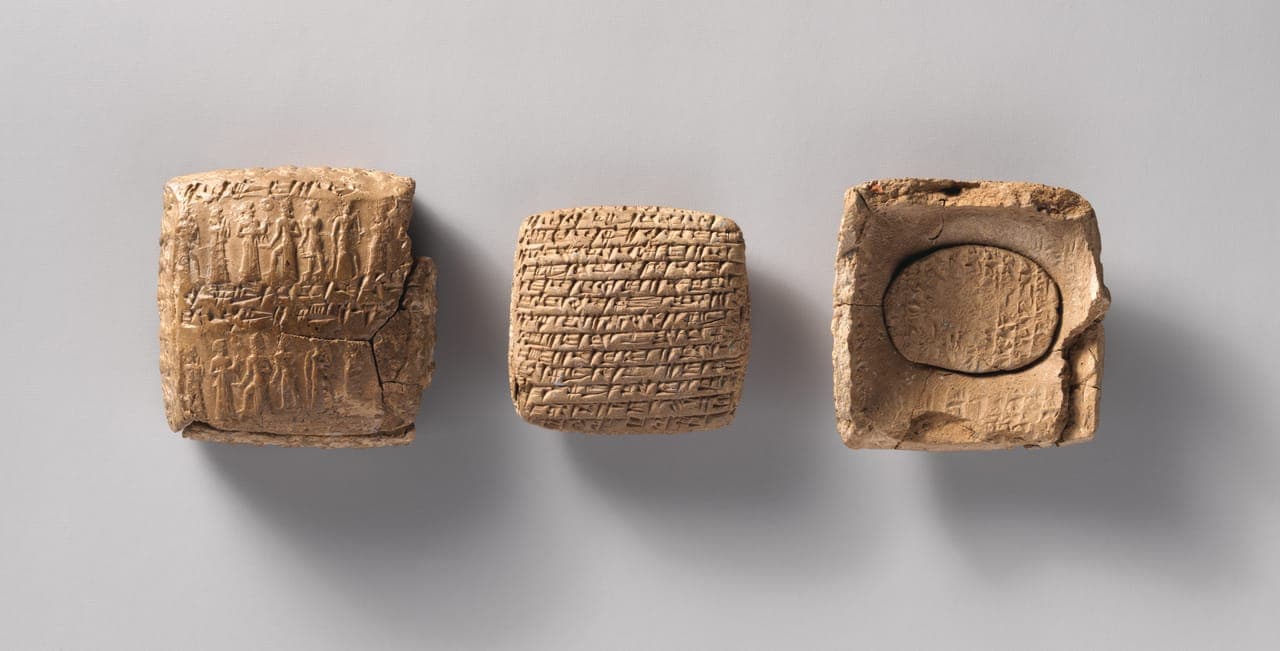
Based on the original, the Metropolitan Museum of Art, New York.
Found: probably Kültepe (ancient Kanesh), central Turkey; no excavation record.
The whole letter, in English
Written in Akkadian, the language of Ashur, by an Assyrian merchant living in Anatolia, about 1900 BC. Our English, checked against Larsen's edition and Hecker's corrections; where they differ, it follows Hecker.
To Walhishna and Kunaniya, say: thus says Ashur-muttabbil. To Walhishna, say:
In the City of Ashur I took one mina of silver from your sister: her rings and her dress pins. Then and there I told her: "For your silver that I took, both slave girls shall be yours." Now I keep hearing that Buzazu has seized your slave girls. Talk to him kindly about them, so they are released to you. If he turns to threats and will not let them go, take it to court. The slave girls are yours.
I left you a third of a mina and 5 shekels of silver. I sent you another 5 shekels with Nishashar, the slave girl from your father's house. That makes half a mina of silver I have left you. Galgaliya is to give you barley worth 7 shekels of silver.
Keep the house's seals safe. Don't keep going out. Guard the house. Don't let Shat-Ashur go hungry. Buy a sheep, so there is meat put by for the little girl. Until you see me again, take heart.
Who's who. Ashur-muttabbil sends it to Walhishna and Kunaniya; the envelope adds a man, Irma-Ashur, who isn't named inside. The letter also mentions Walhishna's sister in the City of Ashur, Buzazu, Nishashar, Galgaliya, Shat-Ashur and "the little girl". How they were related to Ashur-muttabbil, the card doesn't say (see below).
The envelope
The outside carries the address and the sender's name: "To Irma-Ashur, Walhishna and Kunaniya. Seal of Ashur-muttabbil." Under it he rolled his own cylinder seal, one seal only, on the front and both side edges, and twice on the back. The envelope is barely bigger than the tablet: a thin skin of clay, not a box.
The seal impression on our 3D envelope is illustrative. The real one is Pittman's seal 29: a sun god with his saw, one foot on a mountain, a worshipper carrying a goat, a goddess with her hands raised, an armed Ishtar and a youth striding on a platform.
Why an envelope
To keep the letter private: no one could read it without breaking the clay. To protect it on the way. And to prove who sent it, because the sender rolled his seal across the outside. The envelope was pressed round the tablet while it was partly dry, so the two would not stick, and the letter's signs came out as a faint raised mirror image on the envelope's inside.
Still sealed
Hundreds of letters and contracts from Kültepe are still sealed in their envelopes, most of them now in Ankara. For several decades now, nobody has opened them, because opening one breaks its seal impressions. In 2024 a portable CT scanner looked inside about fifty of them without breaking the clay, and scholars read some of the hidden letters. One was a two-tablet letter, like this one.
This letter itself has been opened: its envelope is broken and both tablets are out.
What this card will not tell you
Who Walhishna and Kunaniya were to Ashur-muttabbil. The letter doesn't say, and we have not read the most recent translation or the museum's own label.
When the envelope was opened, in antiquity or in modern times. That is not recorded in anything we have read.
- Larsen 1988, CTMMA 1 no. 78 (the edition: transliteration, translation and hand copies)
- Hecker 1990, NABU 1990/139 (corrections to lines a 8–11, a 31 and b 2–4)
- CDLI P273583 (digital transliteration, Old Assyrian Text Project)
- Pittman 1988, in CTMMA 1, seal no. 29 (the seal rolled on the envelope)
- Michel, Schroer et al., 'Deciphering 4000-year-old cuneiform letters hidden in clay envelopes using a mobile X-ray computed tomography scanner', npj Heritage Science 14, 303 (2026)
- Picture: rendered from our own 3D model, the one on the workbench: a reconstruction, not a record of how it looked.
- Photograph: The Metropolitan Museum of Art, CC0 (via The Met Open Access). Object: The Metropolitan Museum of Art, New York, 1983.135.4a–c. Licence verified 2026-09-27.