- First told
- c. 360 BC
- Oldest source
- Plato, Timaeus and Critias (c. 360 BC)
- Tradition
- Greek
- Region
- Beyond the Pillars of Heracles, in the outer ocean · now the Atlantic just west of the Strait of Gibraltar — Plato's marker; no island is there
- Historicity
- Plato's invention, almost certainly — no Greek before him mentions it. The Bronze Age eruption of Thera may have lent it a memory of a drowned world.
The story
Nine thousand years before Solon — so the old priest of Sais told the Athenian lawgiver, in the temple by the Nile — there was an island in the outer ocean, beyond the Pillars of Heracles, larger than Libya and Asia put together. It was the portion of Poseidon. The sea-god had fallen in love with a mortal girl called Cleito, who lived on a low hill near the middle of the island, and to keep her safe he carved the hill into rings: three of water, two of land, one inside the other, so that no ship could reach her. Cleito bore him five pairs of twin sons. The eldest was Atlas, and from him the island took its name.
The kings who came after built the rings into a city. They bridged the water, cut a canal to the sea, and clad the walls in bronze, in tin, and in a red metal called orichalcum that gleamed like fire and that no one alive has ever seen. At the centre stood Poseidon's temple, roofed in ivory and gold, and beside it a grove of hot and cold springs. The plain beyond the city was ruled straight as a chessboard by canals, and the mountains above it were full of elephants. Every fifth and sixth year, by turns, the ten kings met in the temple, hunted a bull with staves and nooses and no iron at all, and swore over its blood to judge one another by laws written on a pillar of orichalcum.
For many generations they were good, because the god's blood ran in them. But the divine part thinned with every mortal marriage, and the day came when the kings of Atlantis wanted the world. Their fleets came through the Pillars and took Libya as far as Egypt, and Europe as far as Tyrrhenia. Only one city stood against them. It was Athens — not the Athens of Solon's day, but a lost Athens of nine thousand years before, whose citizens lived simply and held everything in common. Deserted by her allies, she fought on alone, broke the invaders, and set the conquered lands free.
Then the gods finished it. Earthquakes and floods came, and in a single dreadful day and night the whole army of Athens sank into the ground, and the island of Atlantis went under the sea and vanished. Where it had been, the ocean turned to shallow mud that no ship could cross, and that, said the priest, is why to this day no one can sail out that way.
That is the shape of the tale as Plato wrote it — in two pieces. The Timaeus tells the outline. The Critias goes back to fill in the city, ring by ring, until the moment Zeus gathers the gods to decide the Atlanteans' punishment and begins to speak. Then the text stops, mid-sentence, and there is no more. Plato never finished it.
How it travelled
Plato dresses the story in a chain of witnesses: Egyptian priests told Solon around 590 BC; Solon told his kinsman Dropides; Dropides told his son Critias, who at ninety told it to his ten-year-old grandson, also Critias, who tells it to Socrates. That is the kind of pedigree a careful author gives a story he wants you to take seriously — or one he wants you to notice is a little too neat. Plutarch, four centuries on, adds that Solon had actually begun a poem about Atlantis and abandoned it, and that Plato picked up the unfinished work.
The ancients themselves split. Crantor, the first commentator on the Timaeus about 300 BC, is reported by Proclus to have taken it as plain history. Strabo preserves a barbed line he found in the philosopher Posidonius: the man who invented Atlantis also made it disappear, the way Homer made the Greeks' wall at Troy vanish so no one could go looking for it. (The internet attributes that jab to Aristotle. Strabo does not; the Aristotle credit is a modern misreading, and Aristotle's surviving works never mention Atlantis.)
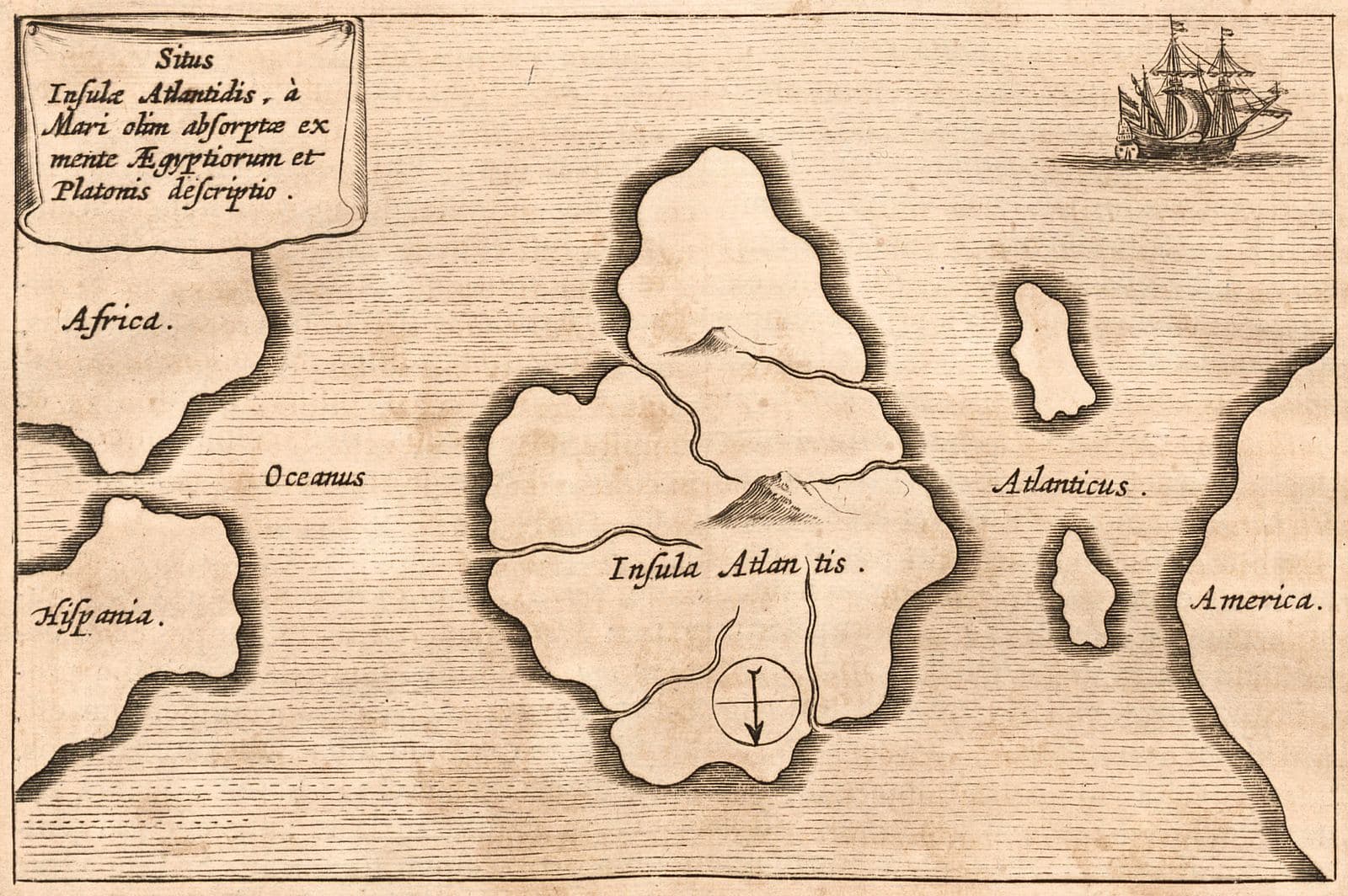
The tale slept in the Middle Ages, when the Timaeus was the only Plato most of Europe could read, and woke with the discovery of America. Suddenly there was a continent beyond the Pillars after all. Francis Bacon borrowed the name for his utopia, The New Atlantis (1626). The Jesuit polymath Athanasius Kircher drew the island onto a map of the Atlantic in 1664–65, with north at the bottom, and accepted Plato's account as literally true. Then in 1882 an American congressman, Ignatius Donnelly, published Atlantis: The Antediluvian World, arguing that every ancient civilisation was a colony of the drowned one. Donnelly's book, not Plato's, is the ancestor of every lost-continent documentary since.
Where history touches the story
Start with what is certain: Atlantis has one source. Plato, writing about 360 BC, is the first person in the surviving record to mention it. No Egyptian text, no earlier Greek poet, no historian — not Herodotus, who visited Egypt and collected its tall stories with enthusiasm — knows of it. That silence is why nearly every classicist who works on the dialogues reads Atlantis as Plato's own creation: a thought experiment about a perfect state going to war, staged as history because Socrates, in the opening pages, asks to see the ideal city "in motion".
What was Plato doing with it? Scholars debate the exact target, but the leading readings overlap. Atlantis is a rich, ring-walled naval empire with a great harbour that overreaches and drowns; the old Athens is a modest land power of citizen-soldiers who win. To a reader in fourth-century Athens that looked a lot like a mirror held up to Athens's own recent naval empire and its collapse — with a flattering ancestor substituted for the real city. Others hear the Persian Wars in it. Kathryn Morgan's phrase for the whole enterprise is "designer history": a past built to teach. Plato even leaves the tell in plain sight, having Critias admit that Solon Hellenised the Egyptian names.
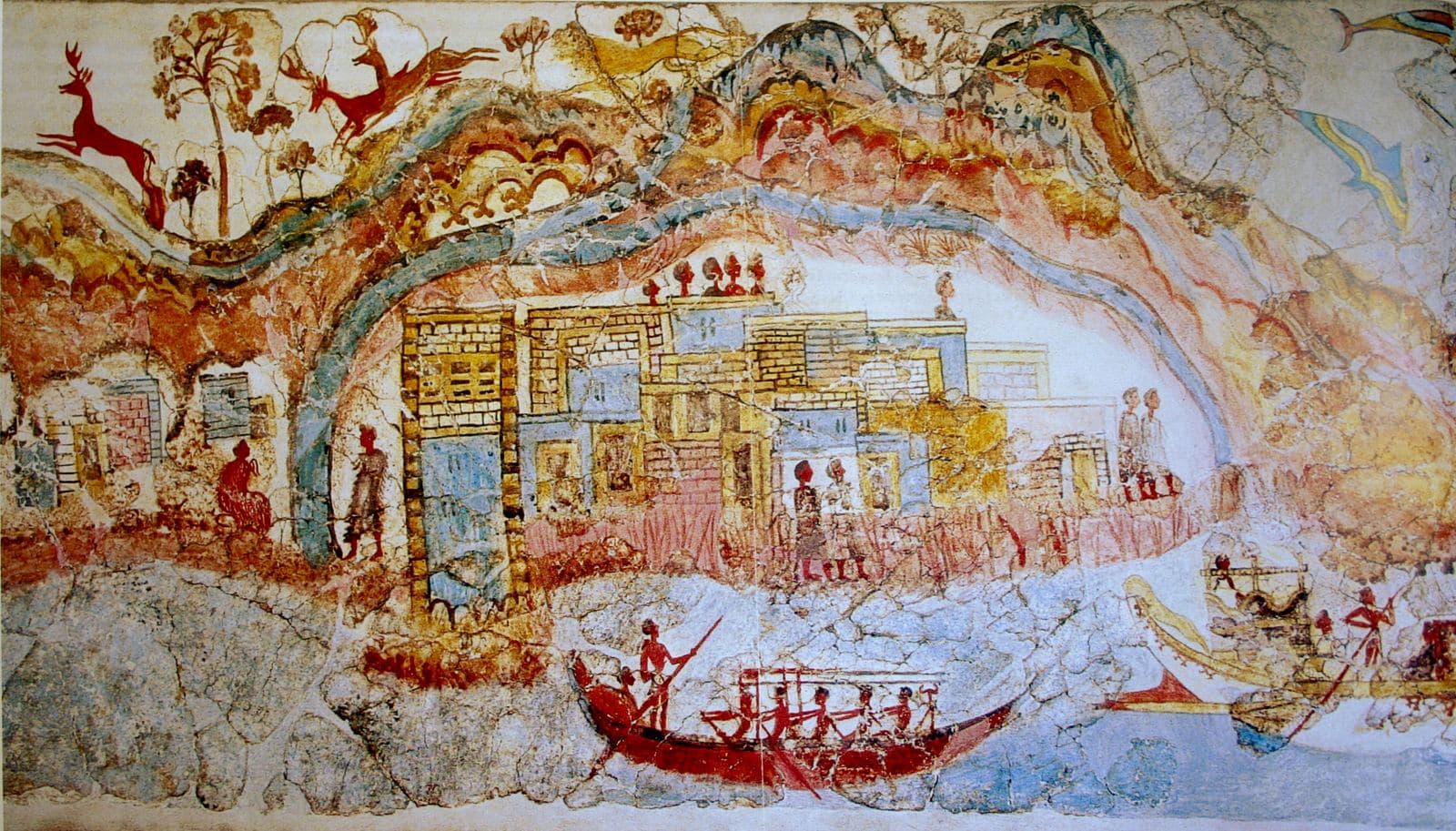
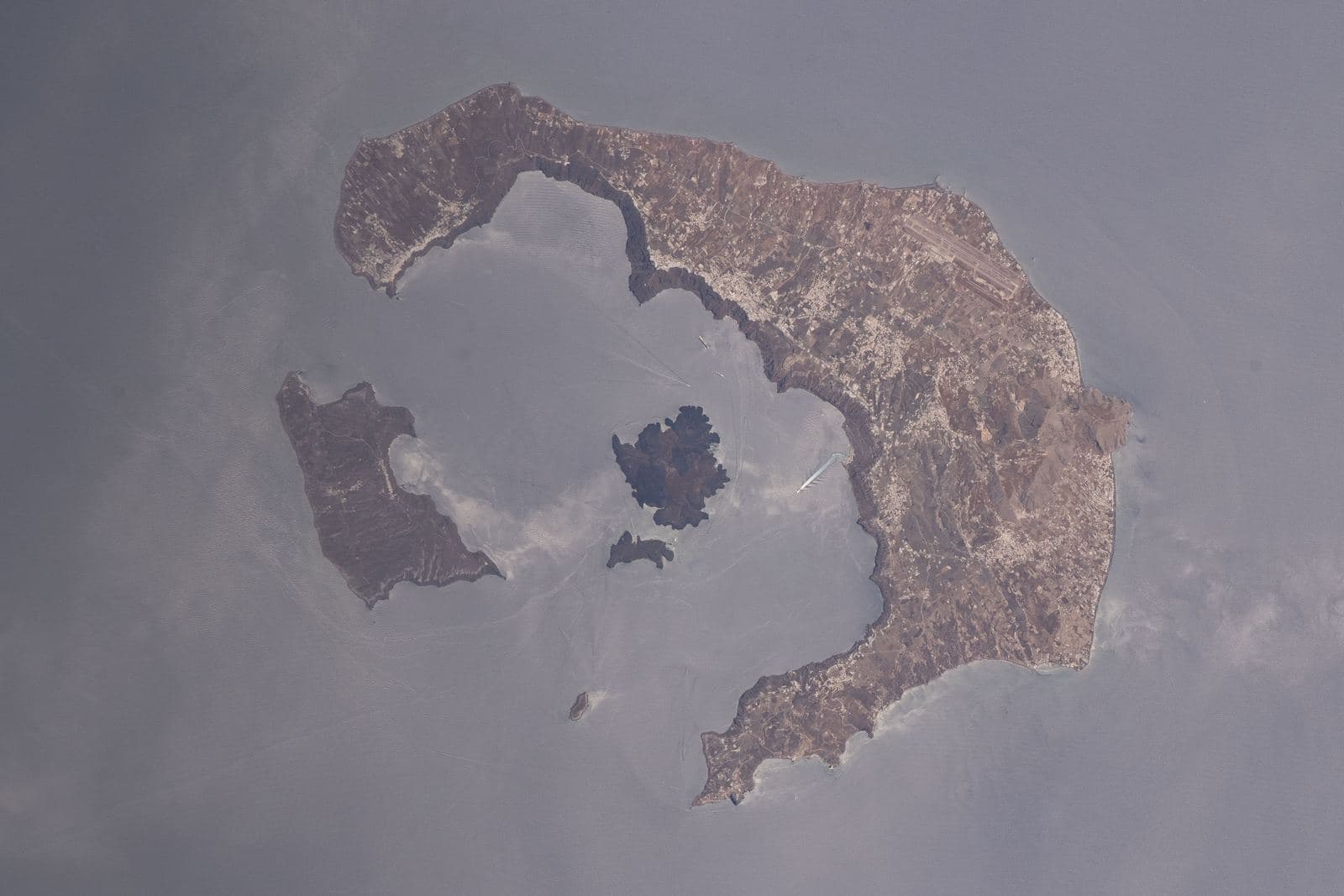
Then there is Thera. Around 1600 BC — the exact year is still fought over by radiocarbon labs and pottery experts, with 1620–1500 BC the honest range — the volcanic island of Thera, today's Santorini, blew itself apart in one of the largest eruptions of the last ten thousand years. The centre of the island became sea. A Bronze Age town at Akrotiri, part of the Minoan world of Crete, was buried under metres of pumice and lay sealed until the archaeologist Spyridon Marinatos began digging it out in 1967. Marinatos had proposed as early as 1939 that the eruption crippled Minoan Crete, and a lively 1960s literature — Galanopoulos, Luce — argued that a garbled memory of that catastrophe, passed through Egypt, was what Plato's priest was really describing. Divide his numbers by ten, the argument went, and nine thousand years become nine hundred; a continent becomes an island.
Weigh that honestly. The eruption is real, the buried town is real, and a Minoan sea power vanishing under ash and wave is exactly the kind of thing a legend could feed on. But nothing links Plato's text to Thera except the wish that it did: the dialogue puts Atlantis in the Atlantic, not the Aegean, twelve centuries too early, and the number-fixing has to be applied selectively to work. Most historians of Plato treat the Thera theory as a modern story about an ancient story — attractive, unproven, and unnecessary, because the dialogue explains itself. On this page, then, the tiers are these: Plato wrote it — certain. He meant it as a parable — the strong scholarly consensus. Thera fed it — a possibility, no more. And the island on Kircher's map — that is pure invention, and worth loving anyway.