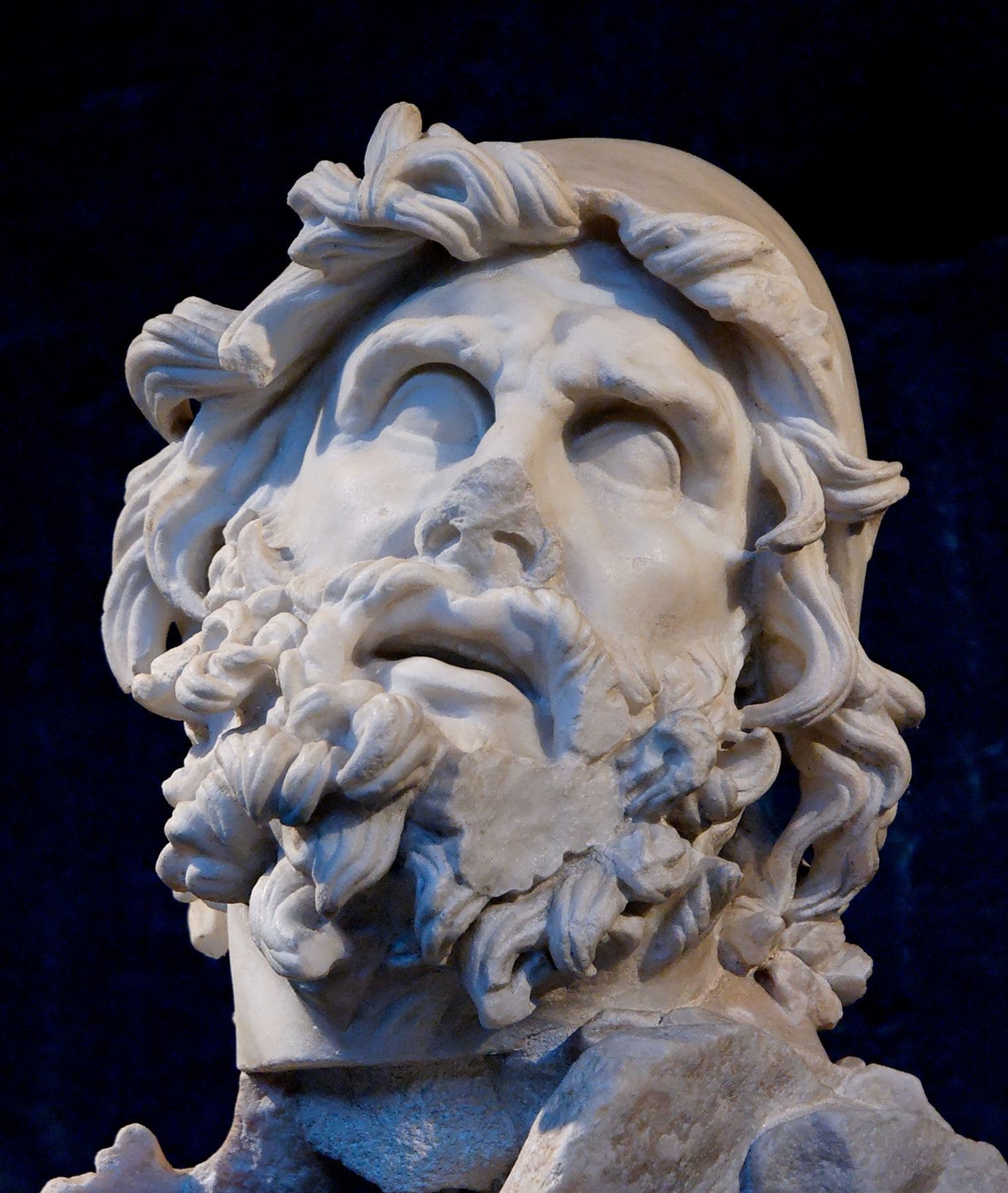
- First told
- c. 700 BC
- Oldest source
- Homer, Odyssey (c. 700 BC)
- Tradition
- Greek
- Homeland
- Ithaca · now Ithaki, Ionian Islands, Greece
- Historicity
- A real Odysseus? Unproven and probably unprovable. Troy was real, and it burned — more than once.
- Known for
- Devising the Wooden Horse, blinding the Cyclops, and taking ten years to sail home to Ithaca
- People
- Achaean (Mycenaean) Greek in the poem's imagination — a Bronze Age island king remembered by Iron Age singers, in a poetic Greek no one ever spoke at home
- Spouse
- Penelope — who waited twenty years and unpicked a shroud by night to stall her suitors (Od. 2, 19)
- Children
- Telemachus (Od. 1–4, 15–24)Telegonus, a son by Circe — not in Homer; from the lost Telegony and later tradition
“I am Odysseus, son of Laertes, known to all the world for my cunning; my fame reaches the sky”
Odysseus introducing himself at the Phaeacian court, Odyssey 9.19–20 — our own rendering of the Greek
Episodesin story order
- Od. 8Ten years at Troy; the Wooden Horse is his idea, sung by the bard Demodocus
- Od. 9Sacks Ismarus, then drifts nine days off the edge of the known map
- Od. 9Blinds the Cyclops Polyphemus and earns Poseidon's curse
- Od. 10Aeolus's bag of winds; Ithaca sighted, then lost when the crew opens it
- Od. 10Circe turns his men to pigs; a year on her island
- Od. 11Down among the dead — Tiresias, his mother, Achilles
- Od. 12Sirens, Scylla, the cattle of the Sun; the last ship and crew are lost
- Od. 5Seven years with Calypso on Ogygia
- Od. 6–8Washed up naked before Nausicaa on Scheria; tells his tale to the Phaeacians
- Od. 13–17Landed asleep on Ithaca; enters his own house as a beggar
- Od. 21–22The bow no suitor can string; the arrow through twelve axes; the slaughter
- Od. 23–24Penelope tests him with the secret of their bed; Athena ends the feud
The man of many turns
The Odyssey opens with a word, not a name: andra, "the man," and then polytropos — a man of many turns, many travels, many tricks. Every translator picks one. Homer, whoever Homer was, meant all of them. Odysseus is the king of Ithaca, a small rocky island off the west coast of Greece, son of Laertes, husband of Penelope, father of Telemachus, and grandson of Autolycus, who "outdid all men in thievery and oaths." It runs in the family.
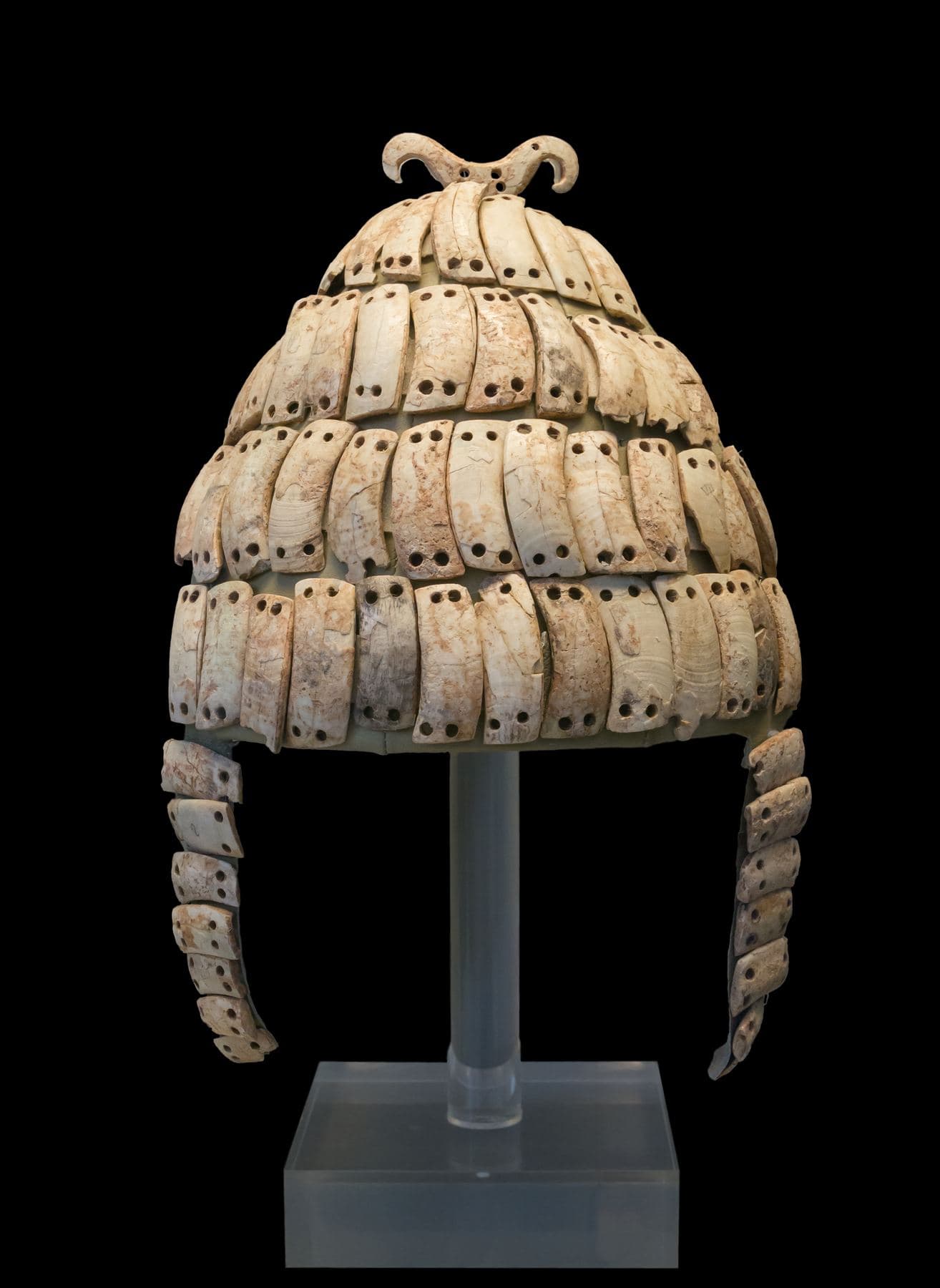
By the time the Odyssey begins, he has already fought ten years at Troy. In the Iliad he is never the strongest man on the field; he is the one you send when talking has to work. He stops the army stampeding for the ships, leads the embassy to sulking Achilles, and goes out on the night raid where a comrade hands him a leather cap studded with boar's tusks — a real Bronze Age helmet, as it turns out, of a kind found in Mycenaean tombs five centuries older than the poem. The Wooden Horse is his idea too, though the Iliad never gets that far: we hear it as a song at a foreign court, when Odysseus, still disguised, asks a bard to sing the tale of the horse and then weeps at his own story.
A word on dates before we go further. Odysseus was "first told" around 700 BC — meaning that is roughly when the poem stopped being improvised by singers and became a fixed text. Scholars argue over fifty years either side. The story it tells is set five hundred years earlier, in a Bronze Age the poet half-remembered and half-invented. And Odysseus himself is a character. No tablet, inscription or object names him before the poem does. Keep that in mind, and enjoy the ride.
The long way home
The famous part — the Cyclops, the Sirens, the witch who turns men into pigs — takes up just four of the poem's twenty-four books, and Odysseus tells it himself, as an after-dinner story to the Phaeacians in Books 9 to 12. He is, we are reminded throughout, a very good liar.
The route starts real. From Troy he sacks a Thracian town, loses six men per ship to the counter-attack, and rounds Cape Malea at the bottom of the Peloponnese — a real cape, proverbially dangerous. Then a storm drives him nine days off the map, and the poet knows it. What follows is fairy-tale country: the Lotus-eaters; the one-eyed giant Polyphemus, who eats six of the crew before Odysseus gets him drunk, blinds him with a sharpened stake, and escapes under the bellies of the sheep — having told the giant his name is "Nobody," so that when the neighbours ask who hurt him, the answer is useless. Sailing away, Odysseus cannot resist shouting his real name, and the giant's father, the sea-god Poseidon, hears it. That boast costs him the next nine years.
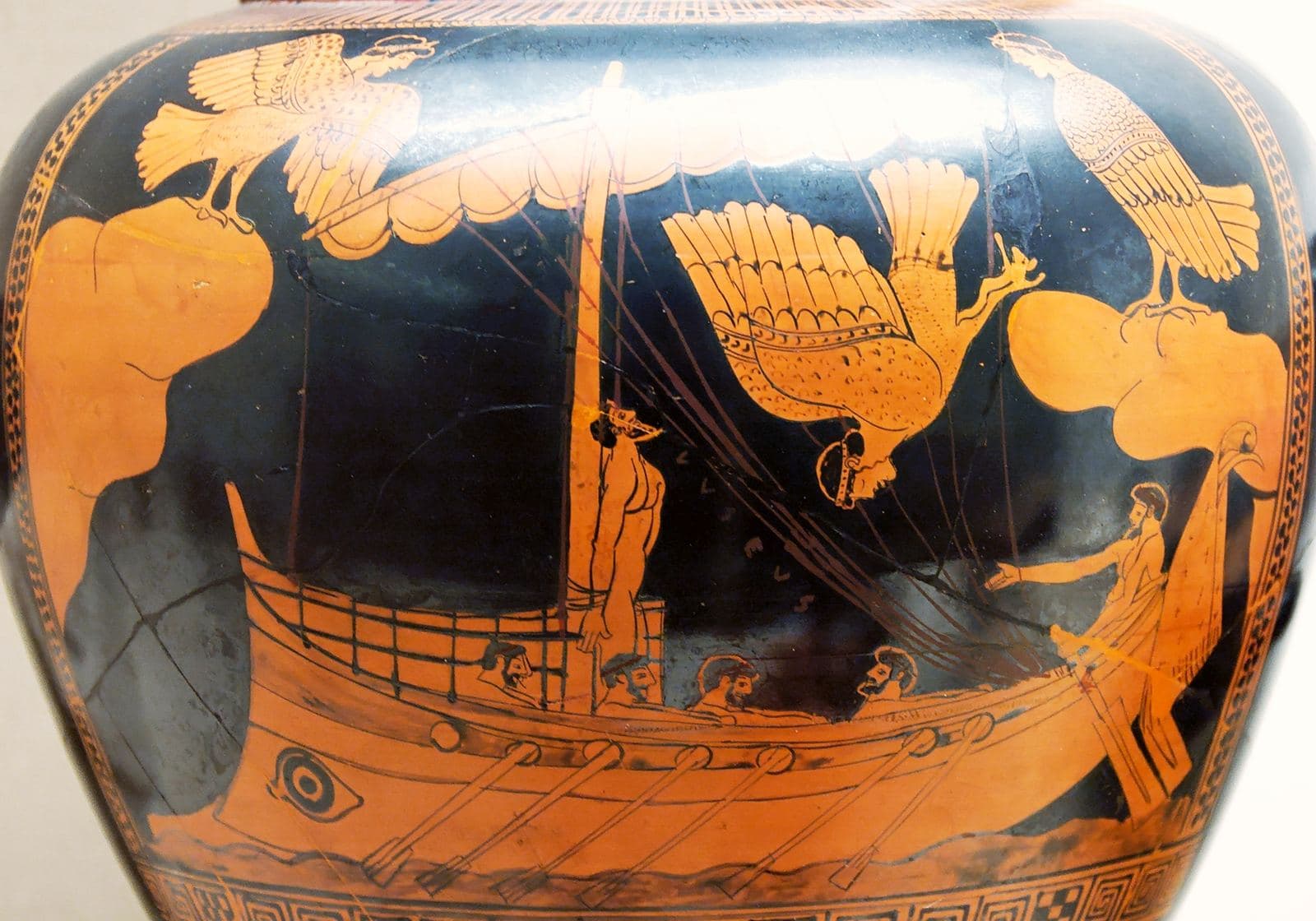
The wind-king Aeolus gives him a bag of winds; in sight of Ithaca, his crew opens it, and they are blown all the way back. The Laestrygonians spear his fleet like fish and leave him one ship of twelve. Circe turns the scouts into pigs, then keeps him a year. He sails to the edge of the world and calls up the dead — his mother, whom he did not know had died; Agamemnon; Achilles, who tells him he would rather be a poor man's hired hand alive than king of all the dead. He gets past the Sirens by plugging the crew's ears with wax and having himself tied to the mast, so that he alone can hear the song and survive it. Scylla takes six more men. On the island of the Sun the starving crew eat the sacred cattle, and Zeus's storm sinks the last ship with everyone aboard except Odysseus, who washes up on Calypso's island and stays seven years.
Where did all this happen? Nowhere, is the honest answer, and the Greeks themselves started the game of pretending otherwise: by the fifth century BC Thucydides could report Cyclopes in Sicily and Phaeacians on Corfu. Our Odyssey map plays the same game with every stop labelled by how old its identification is — some 2,500 years, some invented in 1902 — and repeats the geographer Eratosthenes's verdict from around 200 BC: you will find the route when you find the cobbler who sewed up the bag of the winds.
The beggar in his own hall
The second half of the poem is a different kind of story: no monsters, one house, and a man deciding whom to trust. The Phaeacians land Odysseus on Ithaca asleep. Athena disguises him as an old beggar, and he spends the next several books in his own kingdom being fed by his swineherd, insulted by his wife's suitors — a hundred and eight of them, eating his herds and courting Penelope — and recognised only by his dog, Argos, who wags his tail and dies. His old nurse knows him by a scar on his thigh from a boar hunt in his youth; he grabs her by the throat to keep her quiet.
Penelope has held off the suitors for years with a trick worthy of her husband: she promised to choose one when she finished weaving a shroud for old Laertes, then unpicked each day's work by night, until a maid betrayed her. Now she sets a contest — whoever can string Odysseus's great bow and shoot an arrow through twelve axe-heads may have her. None of them can bend it. The beggar asks for a turn, strings it as easily as a bard strings a lyre, shoots through the axes, and then turns the next arrow on the suitors. With Telemachus and two loyal herdsmen he kills every one of them, in a hall with the doors barred.
Even then Penelope is not sure. She tests him with the one thing only her husband could know: she tells a servant to move their bed outside the bedroom. Odysseus explodes — the bed cannot be moved; he built it himself around the trunk of a living olive tree. Only then does she run to him. The poem ends with the suitors' families arming for revenge and Athena stepping in to stop the blood feud — an ending ancient critics already thought had been tacked on, and one the poem's readers have argued about ever since.
Where history touches the legend
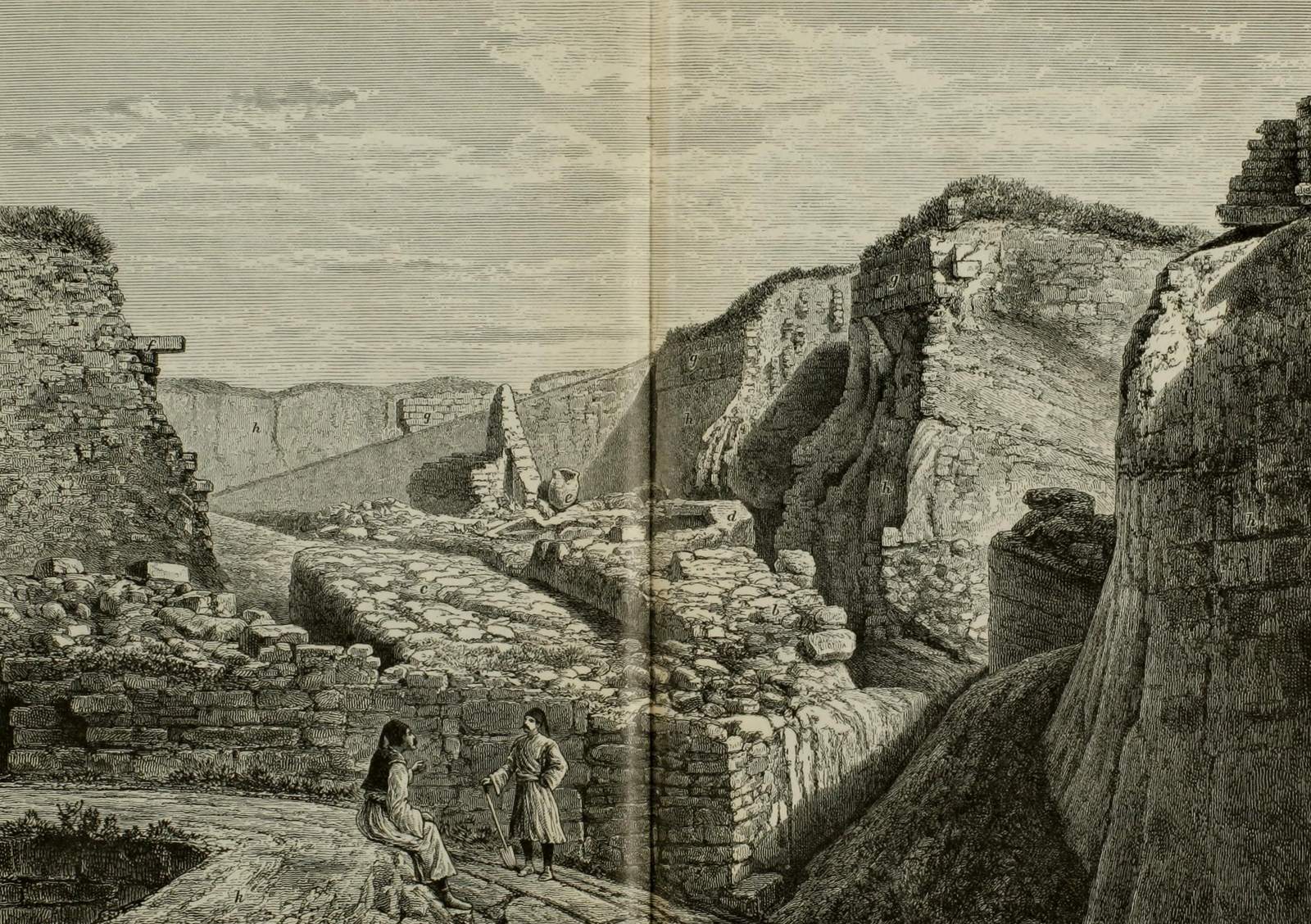
Troy was real. The hill of Hisarlık in north-west Turkey holds nine cities stacked on top of one another, dug out from 1871 by Frank Calvert and Heinrich Schliemann and by four generations of archaeologists since. Two of those cities matter here. Troy VI, in its prime from about 1750 to 1300 BC, had sloping limestone walls up to five metres thick, towers, and a citadel of big houses — a city worth a war. It fell around 1300 BC, probably to an earthquake. Troy VIIa was rebuilt in a hurry inside the same walls, crowded and nervous, with storage jars sunk under the floors, and ended in fire somewhere between about 1250 and 1180 BC, depending on which excavator you follow. A few arrowheads and a few unburied bodies were found in the ash. Nothing found there says who did it.
Hittite clay archives add a second, independent thread. They record a vassal city in the west called Wilusa, which most scholars now identify with (W)ilios, Troy, and a treaty of about 1280 BC between the Hittite king and a ruler of Wilusa named Alaksandu — a name that sounds like Alexandros, the other name of Paris. They also record friction with a western sea-power called Ahhiyawa, which sounds like Achaeans. That is as close as history comes to the Trojan War: a real city, real Greek-Hittite quarrels over it, real destruction. No Odysseus.
The Greek side of the Bronze Age is written in Linear B, the palace accounts deciphered in 1952. They are inventories, not literature, but they show the world the poems dimly remember, and among the ordinary men listed at Pylos and Knossos are an Achilles and a Hektor — common names, not the heroes. There is no Odysseus. What the tablets and tombs do give us is objects the poems describe with uncanny accuracy, like the boar's-tusk helmet above: proof that the singers were carrying real memories from a world five hundred years gone, mixed in with everything else. And on Ithaca itself, in a cave above Polis Bay, excavators in the 1930s found a row of bronze tripod-cauldrons from the ninth and eighth centuries BC — the excavator connected them with the tripods the Phaeacians give Odysseus — and, from around 200 BC, a broken pot inscribed "a vow to Odysseus." Whatever he was, islanders were praying to him by then.
How the story was told and kept
Before it was a book the Odyssey was a performance. Its language is built from ready-made phrases — "wine-dark sea," "rosy-fingered dawn" — that let a singer compose at speed in front of an audience, and the study of living oral poets in the 1930s showed how a tradition like that could carry a story for centuries without writing. At some point in the eighth or seventh century BC, in Ionia on the coast of modern Turkey or on the islands nearby, one version was written down, and that is the text we have. Whether "Homer" was one poet, two, or a name for the tradition itself has been argued since antiquity and is not settled now.
The story travelled fast. Within a generation or two of the text's likely date, Greek potters were painting the blinding of the Cyclops. The Etruscans put him on their mirrors as Uthuze; the Romans made him Ulixes and Ulysses. Physically, the poem survives in scraps of papyrus from Egypt as early as the third century BC, some with extra lines our text does not have, and then in medieval manuscripts, the oldest complete one a tenth-century book in Florence. Alexandrian scholars had already tidied it by then, marking lines they doubted and probably carving it into the twenty-four books we use. It was first printed in Florence in 1488.
After that it never stopped. Dante sent Odysseus on one last voyage past Gibraltar to his death; Joyce gave a Dublin advertising canvasser his name. The one thing every retelling keeps is the thing the first word promised: a man who survives by his wits, lies fluently, and wants, more than glory, to go home.