- First told
- c. 2100 BC
- Oldest source
- Sumerian Gilgamesh poems, Ur III period (c. 2100 BC); the Babylonian epic fixed c. 1200 BC
- Tradition
- Sumerian / Akkadian (Mesopotamian)
- Homeland
- Uruk · now Warka, Muthanna Governorate, Iraq
- Historicity
- Probably a real king of Uruk around 2700 BC — the Sumerian King List names him — but the epic is not his biography.
- Known for
- The oldest surviving epic — his friendship with the wild man Enkidu, the killing of Humbaba, and a journey to the ends of the earth in search of a way not to die
- People
- Sumerian — the people of the world's first cities, who wrote on clay in a language related to no other; his story was retold in Akkadian, the Semitic tongue of Babylon and Assyria
- Spouse
- None named in the epic — he refuses the goddess Ishtar's proposal (Tablet VI)
- Children
- Ur-Nungal, his son and successor according to the Sumerian King List — a list, not a birth record
“Who, my friend, can climb up to heaven? Only the gods live forever under the sun. Our days are numbered; whatever we do is wind”
Gilgamesh to Enkidu, talking him into the Cedar Forest — the Old Babylonian 'Yale tablet' (c. 1700 BC), a version older than the standard epic; our own rendering of the Akkadian
Episodesin story order
- Tablet ITwo-thirds god, king of Uruk, who wears out his own people until they beg the gods for relief
- Tablet I–IIEnkidu is made from clay in the wild and tamed by Shamhat; the animals shun him
- Tablet IIThe wrestling match at the wedding-house door; the two become friends
- Tablets III–VThe journey to the Cedar Forest; Humbaba pleads and is killed
- Tablet VIIshtar proposes and is refused; the Bull of Heaven is sent and slain
- Tablet VIIThe gods decree Enkidu's death; he dreams of the House of Dust
- Tablet VIIIGilgamesh mourns like a lioness robbed of her cubs, and will not bury the body
- Tablet IXPast the scorpion-people, through the mountain's dark, into the garden of jewels
- Tablet XSiduri the tavern-keeper; Urshanabi ferries him across the Waters of Death
- Tablet XIUtnapishtim tells the Flood, and why immortality was a one-off gift
- Tablet XIThe plant that makes the old young again — stolen by a snake while he bathes
- Tablet XIHome to Uruk; he tells the ferryman to climb the wall and admire the brickwork
The king who would not be still
The oldest long story in the world begins with an invitation to look at a wall. Climb up on the rampart of Uruk, the poet says; walk its length; examine the brickwork — is it not baked brick, laid by the seven sages? Then find the copper box in the foundation, take out the tablet, and read of the man who saw everything: Gilgamesh, king of Uruk, two-thirds god and one-third human, taller and stronger and more beautiful than any man, and a disaster to live under.
That is the problem the epic opens on. Gilgamesh is a tyrant. He wears out the young men of the city with contests and labour and takes the brides before their husbands do, and the people of Uruk complain to the gods. The gods' answer is not to punish him but to make him an equal. The mother-goddess pinches off clay and throws it into the wild, and Enkidu is born: hairy, huge, running with the gazelles, drinking at the waterhole with the herds. A hunter whose traps he keeps wrecking goes to Uruk for help, and Gilgamesh sends a temple woman, Shamhat, to tame him. Six days and seven nights she lies with him. When he goes back to the animals, they run from him; he has become a man. She teaches him bread and beer, and brings him to the city.
Enkidu's first act in Uruk is to block the door of a wedding house, where Gilgamesh is coming to claim the bride. They wrestle so hard the doorposts shake. Gilgamesh wins, barely, and then — this is the turn the whole poem depends on — the two kiss and become friends. The tyrant has found the one person who can stand up to him, and the story stops being about a bad king and starts being about love, and what death does to it.
A word on dates, because there are four and they matter. A king called Gilgamesh very probably ruled Uruk around 2700 BC. Poems about him in Sumerian were being sung by about 2100 BC; that is the "first told" date on this page. The Babylonian epic that stitched those stories into the one we read was fixed around 1200 BC. And then it was lost for two thousand years, until 1872.
The Cedar Forest and the Bull of Heaven
Gilgamesh wants glory, and a friend to share it with. He proposes a raid on the Cedar Forest, a sacred mountain far to the west where the god Enlil has set the monster Humbaba to guard the trees. Enkidu, who has lived in the wild, is terrified; the elders of Uruk object; his mother Ninsun prays to the sun-god for his protection and adopts Enkidu as her own son. In an older version of the scene, Gilgamesh's argument is the one we have used for his quote: only the gods live forever, our days are numbered, whatever we do is wind — so let us at least do something worth remembering.
The forest, when they reach it after six days' march, is loud with birds and monkeys — that detail was recovered only in 2014, from a tablet in a museum in Iraqi Kurdistan. Humbaba's seven terrors are stripped from him by the sun-god's winds, and he begs for his life, offering to serve Gilgamesh and cut him all the timber he wants. It is Enkidu who says kill him, quickly, before the gods hear. They do. They fell the tallest cedar and float it down the Euphrates to make a door for Enlil's temple. And then, in that same newly found tablet, the two heroes look at the wrecked forest and feel something like shame.
Back in Uruk, washed and crowned, Gilgamesh is so splendid that the goddess Ishtar proposes marriage. He turns her down with a list of what became of her previous lovers — a bird with a broken wing, a lion in a pit, a horse under the whip, a shepherd turned into a wolf and torn by his own dogs. Furious, she borrows the Bull of Heaven from her father and looses it on Uruk; it kills hundreds with each snort and shakes the city. The two friends kill it, and Enkidu tears off its haunch and throws it in the goddess's face. That night the gods meet. Someone has to pay for Humbaba and the Bull, and it will not be the king.
The road to the end of the world
Enkidu dreams that he is being dragged down to the House of Dust, where the dead sit in darkness eating clay, and he knows what it means. He curses the door he made and the woman who tamed him, then takes it back and blesses her. He sickens for twelve days and dies. Gilgamesh's lament is the emotional centre of the poem: he circles the body like a lioness whose cubs are lost, tears his hair, and will not allow the burial until a maggot drops from his friend's nose. He commissions a statue of Enkidu in gold and lapis, and then he runs. Dressed in a lion skin, he roams the wild his friend came from, and what he is running from is not grief but the thing grief has shown him: that he too will die.
So he goes looking for the one man who did not. Utnapishtim, survivor of the great Flood, lives beyond the edge of the world with a gift of immortality the gods gave once and never again. To reach him Gilgamesh talks his way past the scorpion-people who guard the mountain where the sun rises, walks twelve double-hours through total darkness inside it, and comes out into a garden where the fruit is carnelian and the leaves are lapis lazuli. At the shore of the sea he meets Siduri, a tavern-keeper, who asks why his face is so hollow, and in the older version of the poem gives him the advice the whole epic is arguing with: you will not find the life you seek; fill your belly, dance, wear clean clothes, hold your child's hand, delight your wife — that is what a human being gets. He goes on anyway. A ferryman, Urshanabi, punts him across the Waters of Death, which must not be touched.
Utnapishtim tells him the Flood — the god's warning whispered through a reed wall, the boat, the storm that made even the gods cower like dogs, the mountain, the dove, the swallow, the raven — and then sets a test: if you would defeat death, first defeat sleep for six days and seven nights. Gilgamesh falls asleep at once. The loaves baked beside him each day, mouldering in a row, prove how long. As a consolation Utnapishtim tells him of a plant at the bottom of the sea that makes the old young again, and Gilgamesh dives and gets it. On the way home he stops to bathe in a pool, and a snake smells the plant and carries it off, shedding its skin as it goes. That is why snakes are young forever and we are not. Gilgamesh weeps, and goes home, and says to the ferryman the words the poem opened with: climb the wall of Uruk, walk its length, look at the brickwork. It is all the immortality there is.
Where history touches the legend
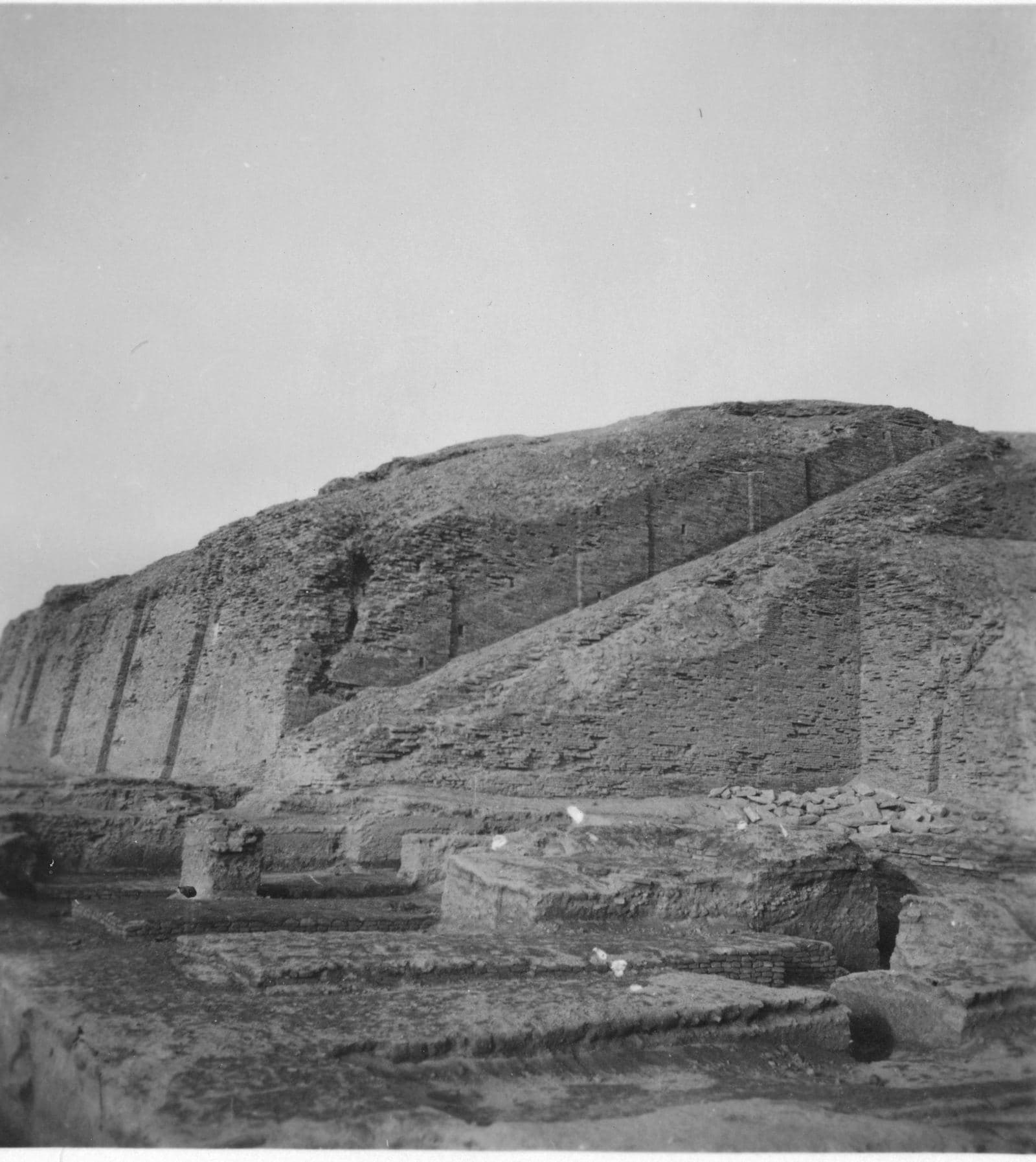
Uruk is real, and enormous. The mound of Warka in southern Iraq was one of the first true cities on earth — home to perhaps fifty thousand people by 3100 BC, and the place where writing was invented. German archaeologists working there between the wars traced its wall: a circuit of some nine kilometres, built of the plano-convex bricks of the Early Dynastic period around 2900–2800 BC. The poem says Gilgamesh built it. The archaeology says the wall is a century or two older than the earliest date anyone gives him. The honest reading is that the most famous king of Uruk was given its most famous monument, and that he may at most have repaired it.
Was there a king at all? The Sumerian King List — a text of about 1800 BC that runs through the dynasties "after kingship came down from heaven" — puts him in the First Dynasty of Uruk: Gilgamesh, "whose father was a phantom, lord of Kulaba, reigned 126 years." The reign lengths are fantasy and the list is political, but its ordering places him next to Aga of Kish, and Aga's father Enmebaragesi is the first king on the whole list whose name has turned up on a real object, a broken alabaster vase. A Sumerian poem has Gilgamesh fight Aga. A later temple record from Nippur credits Gilgamesh and his son with building there. And the kings of Ur around 2100 BC called him their brother and claimed his parents as their ancestors. None of that is a biography. It is the shape a real man leaves in the stories of the people who came after, and most scholars think the shape is real: a king of Uruk, around 2700 BC, whose name became a god's within a few centuries.
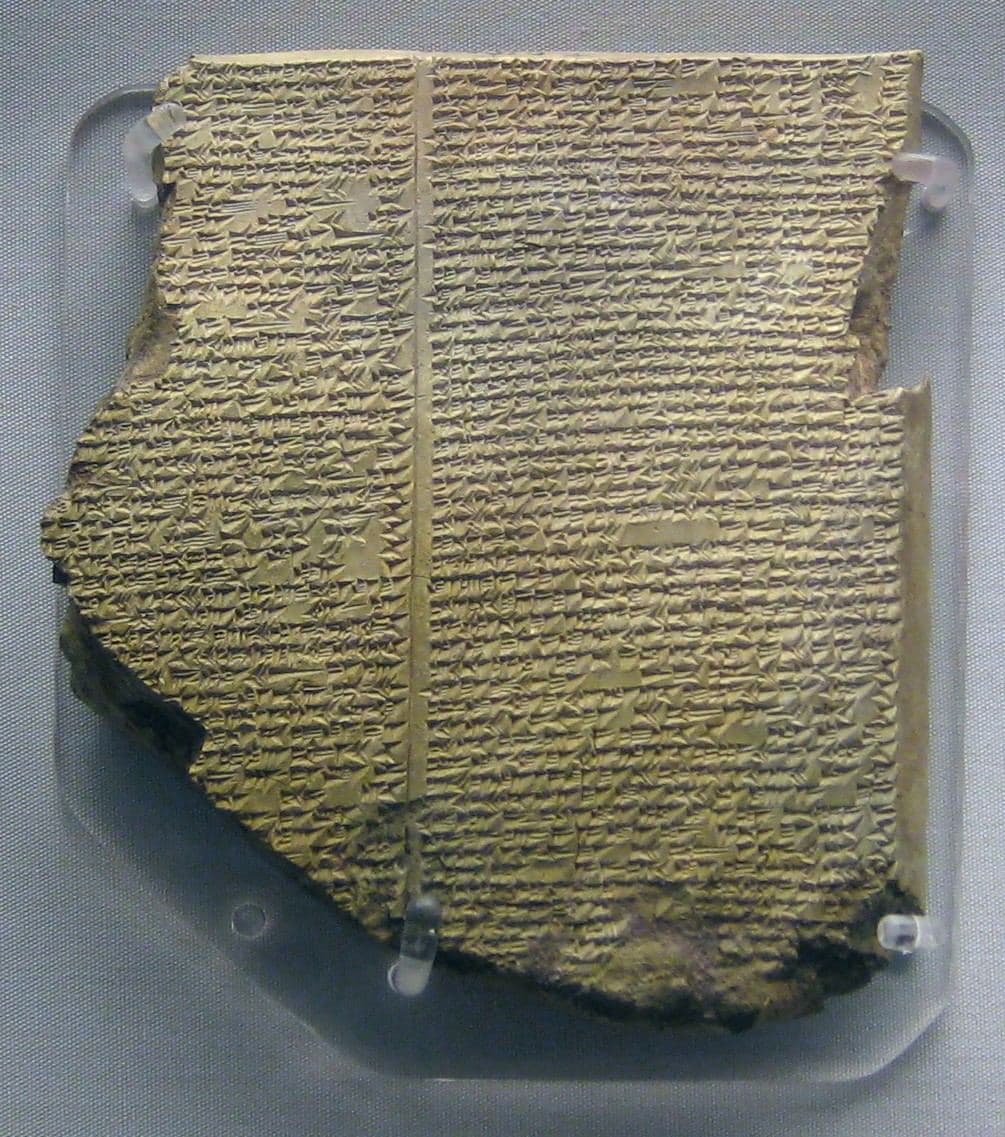
The tablet in the picture above is where the modern story starts. In 1872 George Smith, a banknote engraver who had taught himself cuneiform on his lunch breaks and been hired by the British Museum as an assistant, was sorting broken tablets from the Assyrian royal library at Nineveh when he read of a boat grounding on a mountain and a dove sent out to find land. He announced it to a packed meeting on 3 December 1872 with the Prime Minister in the audience, a newspaper paid for him to go to Iraq to find more, and he did. He died there four years later, aged thirty-six, having brought the oldest epic in the world back from two millennia of silence. What the Flood Tablet proves is not Noah's Ark; it proves that Genesis and Babylon were telling the same much older story, which is more interesting.
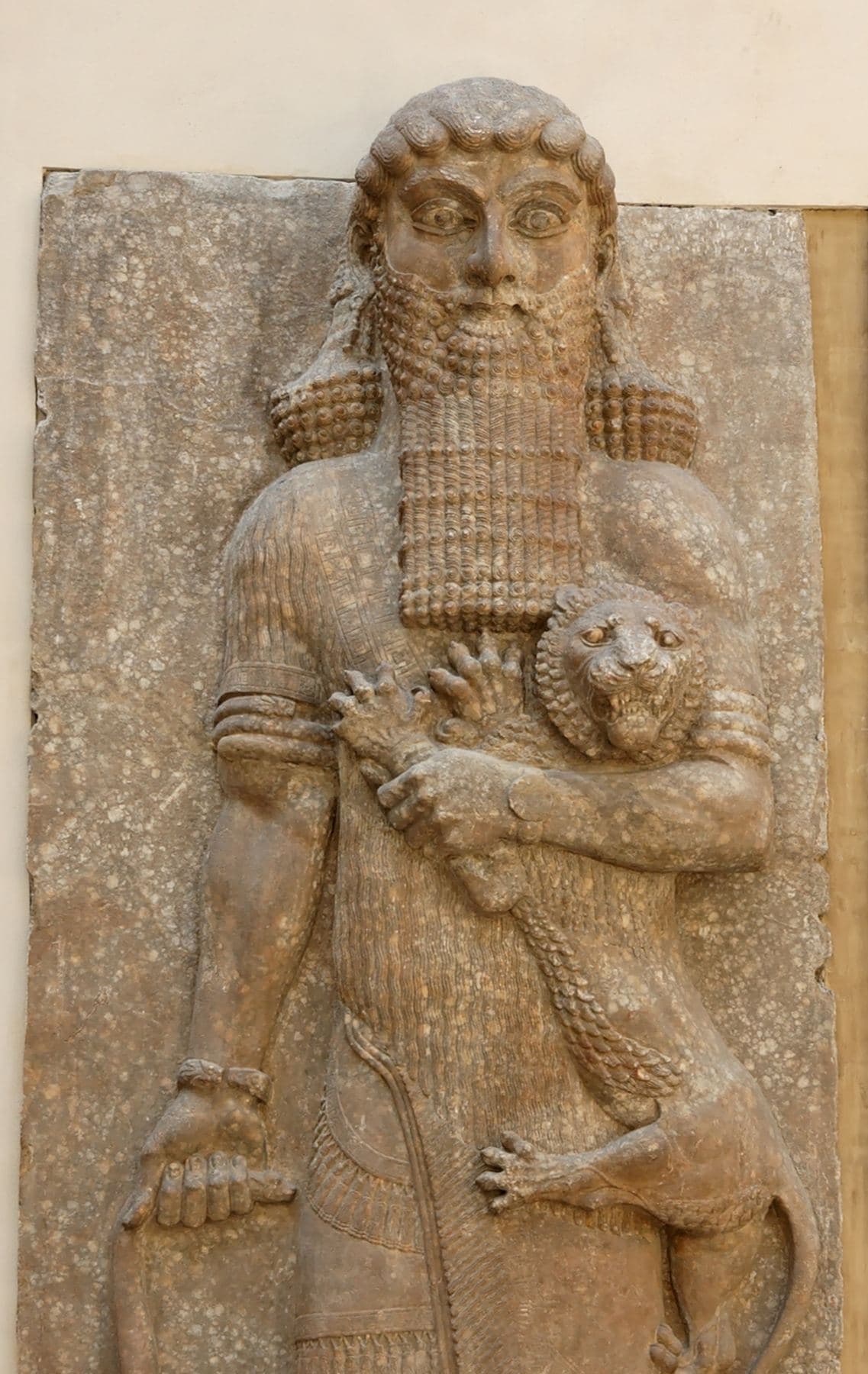
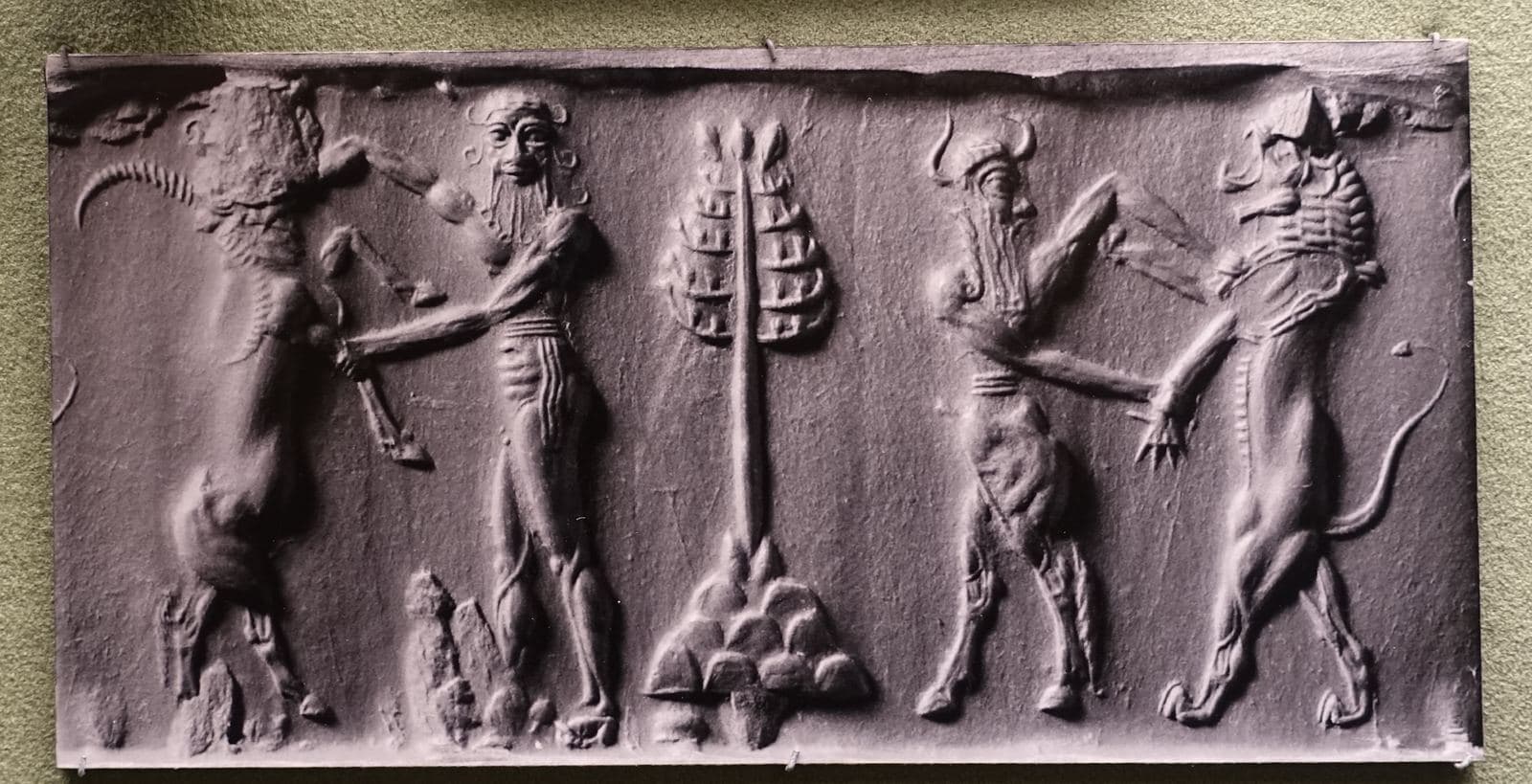
And nothing anywhere is a picture of him. The great stone hero cradling a lion that stands at the top of this page has been called Gilgamesh since the nineteenth century, but it carries no inscription, was carved for an Assyrian palace two thousand years after the king lived, and is more likely a protective spirit. The same goes for the seals of heroes wrestling bulls and lions once labelled "Gilgamesh and Enkidu." We show them because they are what his world looked like, not because they are his face.
From clay to the present
The epic we read is a Babylonian poem in Akkadian, assembled from older Sumerian songs. The Sumerian poems — Gilgamesh besieged by Aga of Kish, Gilgamesh and Huwawa, Gilgamesh and the Bull of Heaven, Enkidu's journey to the underworld, the death and burial of Gilgamesh — were school exercises by 1800 BC, and most of our copies are the clay homework of Babylonian trainee scribes. Around the same time an unknown poet fused them into one Akkadian epic, "Surpassing All Other Kings," which we have only in pieces. Some centuries later, tradition says, a scholar-priest named Sîn-lēqi-unninni gave the poem its final form, "He Who Saw the Deep," in eleven tablets of about three thousand lines, and that is the version that was copied, in Assyria and Babylonia and in translation as far as the Hittite capital in Turkey, for a thousand years. The last copies were made around 100 BC. Then cuneiform died, and the story with it — save for a garbled Greek anecdote about a king "Gilgamos" rescued by an eagle.
Every line we have is a reconstruction. The Nineveh library that Smith worked from had been smashed when the city fell in 612 BC; other copies came from Ashur, Babylon, Uruk itself, and a fragment turned up at Megiddo in Israel. Around two-thirds of the standard text has been recovered, and it is still coming: a tablet bought by a museum in Sulaymaniyah in 2011 gave back twenty lines of the Cedar Forest. The critical edition that all modern translations rest on was published only in 2003. Read a translation from the 1960s and a translation from today and you are reading different amounts of poem.
The thing that has not changed is why people read it. Gilgamesh fails. He does not become immortal, does not keep the plant, does not bring his friend back; he goes home and points at a wall. Four thousand years on, it is still the oldest honest answer to the oldest question, and the story of a self-taught engraver reading it off a broken tablet in a London museum is a fair second act.