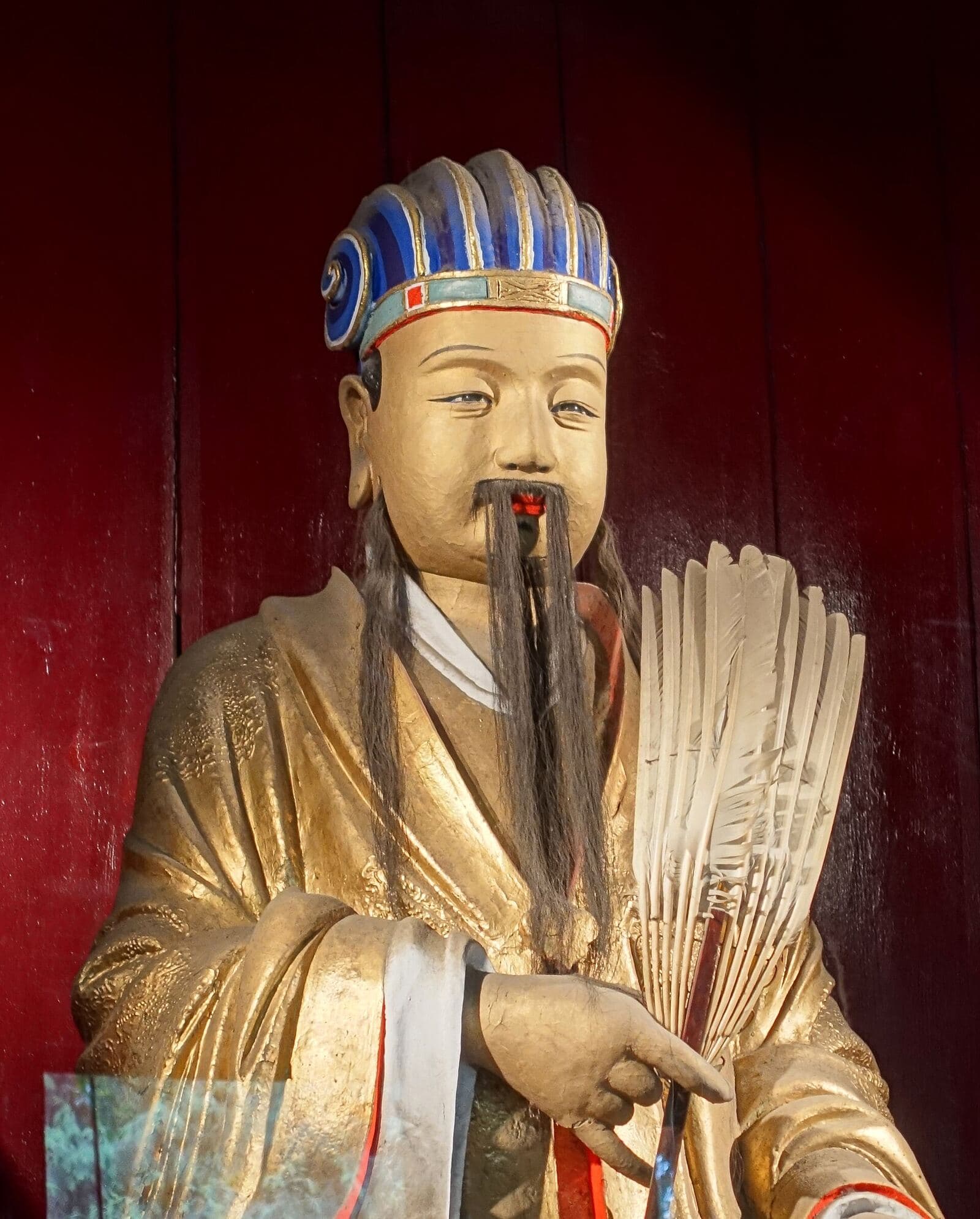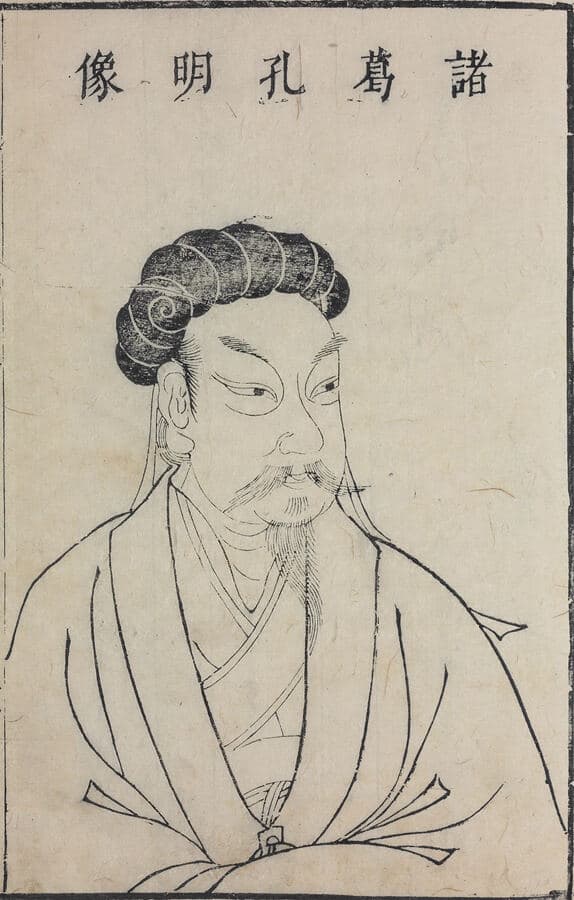
- Born
- AD 181Yangdu, Langya Commandery · now Yinan County, Shandong Province, China
- Died
- AD 234Wuzhang Plains, on the Shu–Wei frontier in Fufeng Commandery · now near Qishan County, Baoji, Shaanxi Province, China
- Known for
- Serving as the incorruptible chancellor of Shu Han, and becoming China's byword for genius despite losing every campaign he personally led
- People
- Han Chinese — a minor Xuzhou official's orphaned son who rose to chancellor of Shu Han, one of the Three Kingdoms into which the fallen Han empire split
- Spouse
- A daughter of the Xiangyang scholar Huang Chengyan, named only as "Lady Huang" in the earliest source — the popular name "Huang Yueying" and the veiled-courtship story are later folklore
- Children
- Zhuge Qiao, an adopted nephew brought into the familyZhuge Zhan, his biological son (b. 227), killed alongside his own son at the Battle of Mianzhu in 263
“I was a man of no rank, tilling the fields with my own hands in Nanyang”
Zhuge Liang, Memorial on Setting Out the Troops (AD 227) — recorded in Chen Shou's Records of the Three Kingdoms, in his own voice
Milestones
- AD 181Born in Yangdu, Langya Commandery, son of a minor Han official
- c. AD 197Orphaned and relocated to Longzhong, near Xiangyang, where he farms and studies for a decade
- c. AD 207Recruited by the warlord Liu Bei after three visits; lays out the Longzhong Plan
- AD 208Negotiates the alliance with Sun Quan that defeats Cao Cao at the Battle of Red Cliffs
- AD 221Liu Bei declares the state of Shu Han and names him chancellor
- AD 223Liu Bei dies; Zhuge Liang becomes regent for the child-emperor Liu Shan
- AD 225Leads the southern campaign into Nanzhong to restore Shu control
- AD 227Submits the Memorial on Setting Out the Troops and launches the first Northern Expedition
- AD 228Loses Jieting through a subordinate's disobedience; executes him and demotes himself three ranks
- AD 234Dies at Wuzhang Plains during a stand-off with Sima Yi, ending the fifth Northern Expedition
Orphan to Recluse
Zhuge Liang was born in 181 in Yangdu, a county in Langya Commandery in what is now Shandong province, the son of a minor Han official who died while he was still a boy. He and his siblings were taken in by their father's cousin, Zhuge Xuan, who moved the family south as the Han dynasty tore itself apart in civil war. When Zhuge Xuan died around 197, Zhuge Liang settled near Longzhong, outside Xiangyang, in the relatively stable territory of the warlord Liu Biao — and farmed.
He spent roughly a decade there, studying and building friendships among Jingzhou's community of displaced scholars. Popular tradition remembers him from this period as the "Sleeping Dragon" — a genius already recognized, waiting only to be discovered. The history is more modest: a well-connected, well-regarded young man with local admirers, not yet tested in any office. The flattering legend of the settled, almost supernatural reputation is a retrospective gloss added by people who already knew how the story ended.
He married during these years, too — a daughter of the respected local scholar Huang Chengyan. The marriage itself is solidly attested, in a fifth-century annotation to the history rather than in the history's own original text. Nearly everything else repeated about her today — her personal name, the legend that she was brilliant but plain and chose her own husband from behind a veil, even the folk credit she sometimes receives for his later inventions — appears nowhere before much later popular storytelling.
The Longzhong Plan
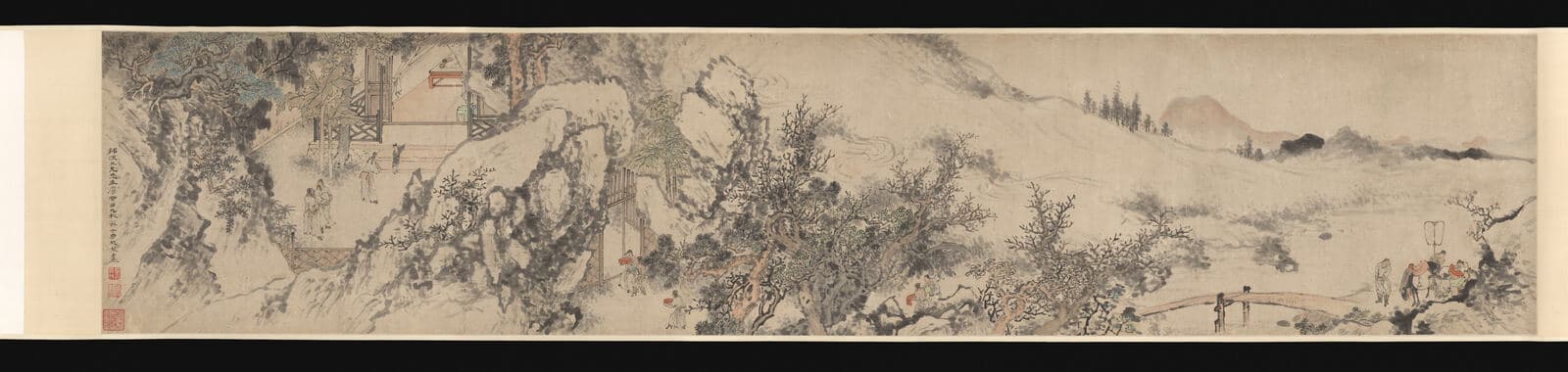
In 207, the warlord Liu Bei — freshly defeated and looking for an edge — visited Zhuge Liang three times before the two men actually sat down together. That sentence is close to the entirety of what the contemporary-ish history actually says about the recruitment. Everything that makes "the three visits to the thatched cottage" a beloved scene — Liu Bei turned away twice by servants, riding through snow, waiting patiently while Zhuge Liang naps — was written eleven centuries later, for a historical novel. It is vivid, and it is fiction.
What is attested is the substance of what they discussed: the Longzhong Plan. Secure the two provinces of Jing and Yi — roughly modern Hubei/Hunan and Sichuan — as a territorial base; ally with the southern warlord Sun Quan; and from that base, eventually strike north at the dominant power, Cao Cao. It became the actual strategic skeleton of the rest of Liu Bei's career, and of the state that followed. A rival early tradition even claims the order of events was reversed — that Zhuge Liang sought out Liu Bei first. Historians have never fully settled which came first; both the courtship and the plan it produced are real, even if the famous dramatization of their meeting is not.
Red Cliffs and the Alliance with Wu
After Liu Bei's catastrophic defeat and flight south in 208, Zhuge Liang was sent to negotiate with Sun Quan. He argued forcefully at Sun Quan's court that resistance, not surrender, was the right call against Cao Cao's advancing army — and helped tip an internal debate toward war. The resulting alliance met Cao Cao's forces at Red Cliffs on the Yangtze that winter. Fire was turned against Cao Cao's fleet, and his southern advance was decisively halted — arguably the single most consequential battle of the entire period, since it is what made a genuine three-way division of China possible at all.
Zhuge Liang's role in this, by every sober account, was diplomatic. The battle itself was commanded by the Wu general Zhou Yu. None of that stopped a later storyteller from giving Zhuge Liang the credit for the battle's two most famous moments. In the novel, he tricks Zhou Yu's archers into "donating" a hundred thousand arrows by sending padded straw boats into the fog, then performs a ritual atop an altar to summon the southeast wind the fire attack needed. Neither scene appears anywhere in the earliest histories. He talked Sun Quan into fighting. He did not command the battle, summon the wind, or trick anyone out of their arrows — that version was written more than a thousand years later.
Chancellor of a Small Kingdom
Liu Bei declared himself emperor of Shu Han in 221 and made Zhuge Liang his chancellor. After a disastrous defeat against Sun Quan the following year, Liu Bei died at Baidicheng in 223, and Zhuge Liang became regent for his young heir, Liu Shan — a position he held, without ever seizing the throne himself, for the rest of his life. Liu Bei's deathbed instructions were recorded in a famously ambiguous form, suggesting Zhuge Liang should feel free to "take the position" if the boy proved unfit; historians still argue over how far that offer really went. What is not in dispute is that Zhuge Liang never acted on the maximal reading of it.
What he did instead was govern — strict, evenly applied law, careful management of a small and resource-poor state squeezed between two much larger rivals. A small bureaucratic scandal from 231 shows the texture of it well: his co-official Li Yan forged an order claiming the emperor wanted a retreat, then tried to blame the retreat on Zhuge Liang while separately telling the throne that supplies had been fine all along. Zhuge Liang produced Li Yan's own contradictory letters to expose the lie, and had him stripped of rank. It has none of the novel's drama, and it is exactly the kind of evidence that supports a reputation for integrity that the history, not just the legend, actually earns.
The Northern Expeditions and Death
Between 227 and 234, Zhuge Liang launched five campaigns against the rival state of Wei, aimed at the region around Mount Qi. None of them permanently took Wei territory. The worst reversal came in 228, when a subordinate, Ma Su, disobeyed orders and camped on high ground away from water, leading to a crushing defeat at Jieting. Zhuge Liang had Ma Su executed for it — and then, in a detail often left out of the legend, voluntarily petitioned to demote himself three ranks to take public responsibility for the failure. The emperor granted it.
The fifth and final expedition, beginning in 234, brought his army into a long stand-off with the Wei general Sima Yi at the Wuzhang Plains. Sima Yi, from the stronger and richer state, simply refused to fight — a patient strategy that historians generally credit as the correct, if unglamorous, choice against an opponent who could not afford a long war. Zhuge Liang died at the camp during that stalemate, worn down, by most accounts, from personally overseeing nearly every detail of Shu Han's army and government rather than delegating it. The Shu army withdrew, and the Northern Expeditions ended with him. One of the most famous stories about this final campaign — that he bluffed Sima Yi's army into retreating from an undefended city by sitting calmly on the walls playing a stringed instrument — is a novel invention that does not fit Sima Yi's actual recorded movements at all.
Legacy
Zhuge Liang was given the posthumous title Marquis Zhongwu, and shrines to him — Wuhou Ci, "Shrine of the Marquis of Wu" — were raised at sites across Shu Han territory, the most famous in Chengdu, rebuilt in its present form in 1672. His name became genuinely proverbial: "three ordinary cobblers together equal one Zhuge Liang," the saying goes, meaning collective wisdom beats a lone genius — itself a small irony, repeated for centuries using his name as the measure of unmatched brilliance.
That brilliance, on the sober record, rests on a narrower set of achievements than the legend remembers: a sound initial strategic plan, competent diplomacy, rigorous and fair administration of a small state, and a personal integrity he never had to be forced into. The novel that followed eleven hundred years after his death gave him wind-summoning rituals, trick arrows, and an unbroken run of genius victories. The real man lost every campaign he personally led in the field, and is still, by any fair reading of what actually survives, one of the most capable statesmen his era produced. He built a state so well that it outlasted him by thirty years — run, by then, on the foundations he laid.