- Born
- c. 164 BCChenggu, in Hanzhong commandery · now Chenggu County, Hanzhong, Shaanxi, China
- Died
- c. 113 BCUnrecorded — presumably Chang'an, the Han capital · now presumably Xi'an, Shaanxi, China; he was buried back home at Chenggu
- Known for
- Walking west for thirteen years, surviving two Xiongnu captivities, and bringing home the first reliable Chinese account of Central Asia
- People
- Han Chinese — a minor court official of Emperor Wu's Han empire, from the river country of what is now southern Shaanxi; his world wrote in classical Chinese and measured distance in li
- Spouse
- An unnamed Xiongnu woman, given to him during his captivity — the Shiji records that she existed and bore him a son, and nothing else, not her name nor whether she had any say in it
- Children
- A son, born in captivity among the Xiongnu — the Shiji says he existed and came home to Han, and records nothing further
“Cut off the right arm of the Xiongnu”
His argument to Emperor Wu for courting the Wusun, as reported in Sima Qian's Shiji 123 — the only text on earth that preserves anything he is supposed to have said
Milestones
- c. 164 BCBorn at Chenggu in Hanzhong — the year is a modern guess; no source records it
- c. 138 BCVolunteers to carry Emperor Wu's alliance offer to the exiled Yuezhi, and rides west with over a hundred men
- c. 138 BCCaptured in the Hexi Corridor almost at once; held by the Xiongnu for more than ten years
- c. 129 BCEscapes west and reaches Ferghana, Sogdiana, the Yuezhi and Bactria — and is refused the alliance
- 126 BCReturns to Chang'an after thirteen years; two men come back out of more than a hundred
- 123 BCGuides Wei Qing's army to water and pasture and is made Marquis of Bowang
- 121 BCArrives late to the rendezvous with Li Guang; condemned to death, buys his life, stripped to commoner
- c. 119 BCSecond mission west — 300 men to the Wusun, with deputy envoys fanned out as far as Parthia and India
- 115 BCReturns with Wusun envoys and is appointed Grand Usher, one of the Nine Ministers
- c. 113 BCDies about a year later; some sources put it in 114 BC
A Gentleman Volunteers
Before anything else, one thing has to be said plainly, because it shapes every sentence that follows. Almost everything known about Zhang Qian comes from a single chapter of a single book: chapter 123 of Sima Qian's Records of the Grand Historian, the Shiji, written within a generation of his death. There is no second account, no letter in his hand, no inscription, no foreign record that mentions him. The one text that looks like corroboration — the Book of Han, compiled 150 years later — mostly copies the Shiji. So this is a life we know from one witness, and scholars are not even fully agreed that the chapter as we have it is the one Sima Qian wrote.
What that witness tells us starts around 138 BC, at the court of Emperor Wu of Han. For sixty years the Han empire had been buying peace from the Xiongnu, the nomadic horse confederation on its northern frontier, by sending princesses, silk and grain north — tribute under a politer name. Emperor Wu's generation was the one that decided to stop paying. And from Xiongnu prisoners the Han had heard something useful: the Xiongnu had crushed a people called the Yuezhi, killed their king, and turned his skull into a drinking cup. The survivors had fled somewhere far west, carrying a grudge and no means to act on it.
The emperor wanted to find them and propose a pincer. He had no idea where they were, how far it was, or what lay in between — nobody at his court did. So he asked for volunteers. A junior palace gentleman from Chenggu in Hanzhong, a man named Zhang Qian, put his hand up. He left with over a hundred men and a guide: an enslaved Xiongnu man named Ganfu, also called Tangyi Fu, who belonged to the Tangyi household. Remember Ganfu. He is going to be half of how this ends.
One honest note on the dates before we go. The Shiji does not actually say "138 BC" — it dates the departure only to a reign period covering 140 to 135 BC, and 138 is the settlement modern historians reached. His birth year is worse: no source gives one at all. The "c. 164 BC" on this page is a convention borrowed from modern reference works, and published guesses range across thirty years. Nobody knows when Zhang Qian was born.
Ten Years a Captive
To go west you had to cross the Hexi Corridor, the long gravel throat between the Gobi and the Tibetan plateau — and in 138 BC that ground belonged to the Xiongnu. The mission was caught almost immediately, barely out of Han territory.
Zhang Qian was brought before the chanyu, the Xiongnu supreme ruler, and got an answer that deserves more attention than it usually gets. The Yuezhi, the chanyu pointed out, lie to the north of me. If I wanted to send envoys south through your territory to the state of Yue, would the Han let them pass? It is a perfectly reasonable diplomatic argument, and it is very nearly the only moment in this whole story where the Xiongnu get to speak for themselves rather than being described by the people they fought.
Then the Shiji does something maddening. It spends roughly two sentences on the next decade. Zhang Qian was detained "more than ten years." He was given a wife. He had a son by her. And — this is the line on which two thousand years of Chinese memory of him rests — through all of it he kept the emperor's envoy-staff and did not lose it. That staff, the han jie, was the physical token of his commission: as long as he held it, he was still an ambassador rather than a prisoner. He carried it through ten years of captivity in a language not his own.
Everything else about those years is a blank. Whether he was content, whether he loved his wife, what he told his son, what he thought about at night — we have nothing, and any documentary that shows you those scenes is inventing them. What we can say without inventing anything is structural: ten years inside the Xiongnu confederation turned a minor court official into the only man in the Han empire who understood the steppe from the inside. That knowledge is going to get him a marquisate later. It is also worth correcting a very common error here: you will often read that he was "enslaved for thirteen years." Thirteen years is the length of the whole journey. The captivity was ten-plus, with a second, shorter one still to come.
The Escape, and the Road On
At some point — the year is not recorded, roughly 129 BC — he was being watched loosely enough to run, and he ran. Not east toward home. West, in the direction he had been sent a decade earlier, still carrying the staff.
The route the Shiji gives is a chain of names, not a road. Tens of days of travel brought him to Dayuan — the Ferghana Valley, in what is now Uzbekistan and Kyrgyzstan. Its king had heard rumours of Han wealth and wanted contact, so he supplied guides onward through Kangju, the Sogdian country around Samarkand, and on to the Da Yuezhi, who had ended up settled north of the Amu Darya, having conquered Daxia — Bactria, in northern Afghanistan. He had found them. It had taken him about twelve years. Worth stressing that those are the peoples the text names, not the passes he used: every map ever drawn of this journey, this site's included, is a modern reconstruction, and whether he went north or south of the Taklamakan desert is simply not recoverable from what Sima Qian wrote.
And the Yuezhi said no. Not out of fear — out of contentment. They had a new king, land richer than anything they had lost, no neighbour strong enough to trouble them, and no remaining appetite for revenge on the Xiongnu. Zhang Qian stayed about a year, arguing. He got nothing. He had spent a decade of his life in captivity to deliver a message to people who had moved on.
Then he tried to come home the clever way, taking a southern line along the Nanshan mountains through Qiang country specifically to avoid Xiongnu ground — and was caught anyway, and held about another year. He got out only because the chanyu died in 126 BC and the succession collapsed into a fight between the old ruler's brother and his heir. In the confusion Zhang Qian escaped, taking his Xiongnu wife with him, and Ganfu. He reached the Han capital in 126 BC, thirteen years after he had left it. Of the hundred-plus men who rode out, two came back. The Han court made Zhang Qian a Palace Counsellor. It gave Ganfu, who had been a slave when they set out, a title of his own: Lord Who Fulfilled the Mission.
The Report That Changed a Dynasty
Here is the part that actually mattered, and the Shiji does something unexpectedly rigorous with it: it separates what Zhang Qian saw from what he was told. The chapter marks off the four places "he personally reached" — Ferghana, Sogdiana, the Yuezhi lands and Bactria — from the rest, which is explicitly flagged as report and rumour. A two-thousand-year-old text sourcing its own claims is a gift, and we should be at least as careful as it was.
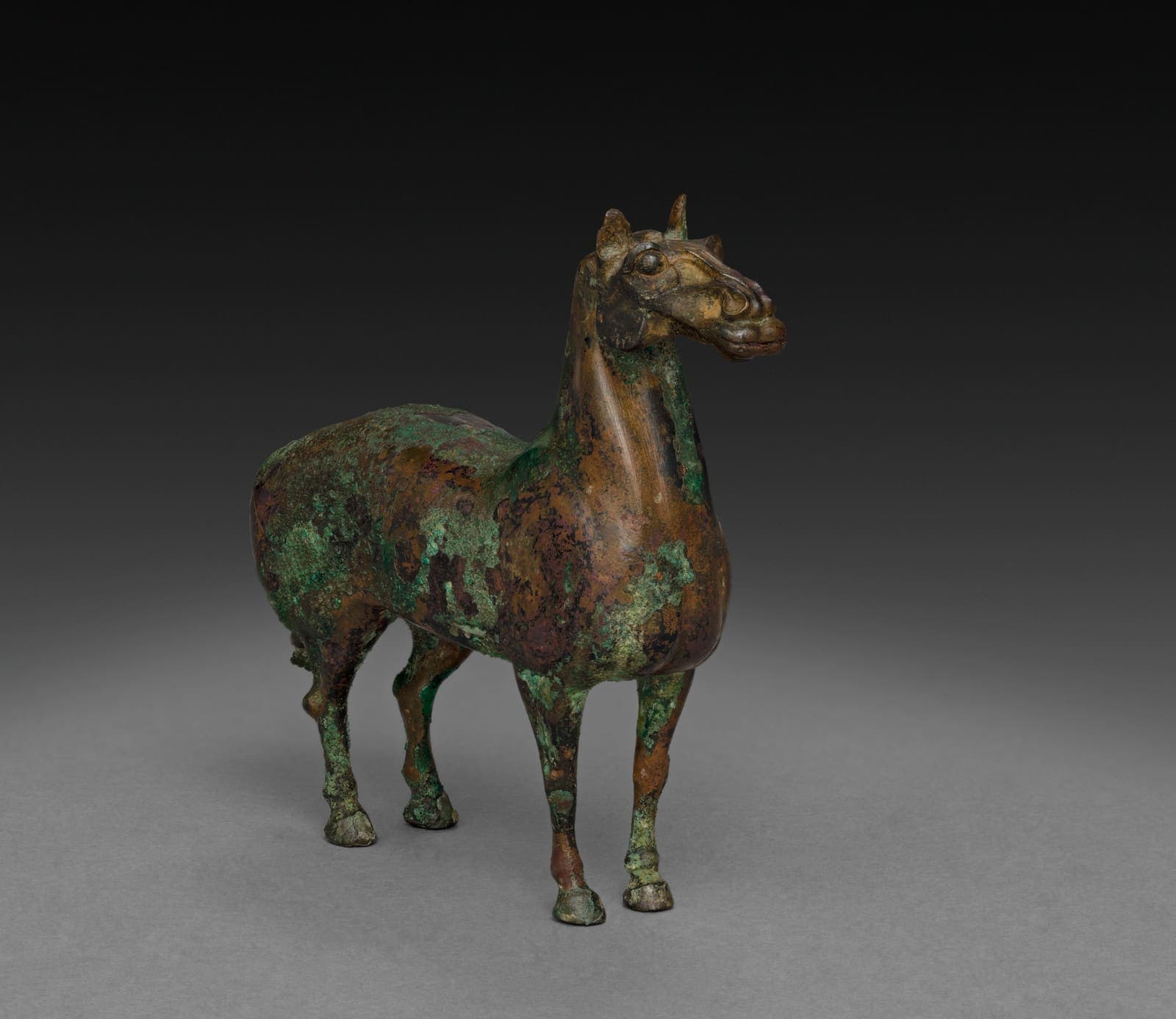
What he saw: Ferghana had walled towns, irrigated fields of rice and wheat, wine made from grapes, and horses so fine they were said to sweat blood and descend from heavenly stock. Bactria had no great king at all — just a scatter of small city-lords, a feeble army, and superb merchants working a big market at the capital. What he was told: that far to the west lay Anxi — Parthia — an empire of hundreds of walled towns whose people wrote on horizontal strips of leather and used silver coins stamped with the reigning king's face, restruck each time a king died. That description is astonishingly accurate for hearsay; Parthian drachms do carry royal portraits, and parchment was the medium. Further out still were a hot country of enormous birds' eggs and conjurers, a nomad people beside a shoreless lake, and Shendu — India — low, hot, humid, with warriors who fought from elephants.
But the single most important thing he noticed was small and commercial. In the markets of Bactria he saw cloth from Shu and bamboo canes from Qiong — both from Sichuan, in southwestern China. He asked how they had got there. Bought in India, the merchants told him, which lies southeast of here. Zhang Qian drew the right conclusion and reported it to the emperor: there must be a southwestern route, from Sichuan through India to Bactria, that bypasses the Xiongnu entirely. Emperor Wu funded expeditions to find it. They were blocked by the peoples of Yunnan and failed, and Zhang Qian never saw India.
That bolt of Sichuan cloth deserves a moment, because it quietly demolishes the tidiest version of this story. Chinese goods were already reaching Central Asia before Zhang Qian got there. Passed hand to hand along routes nobody had mapped, by merchants nobody had recorded, trade was happening. He did not create it. He walked into it, recognised what he was looking at, and told a state that had the armies and the treasury to turn a rumour of a route into a policy.
Marquis, Disgrace, and a Second Road West
For a few years his decade in captivity paid off in the most practical way imaginable. In 123 BC he rode on campaign against the Xiongnu with the general Wei Qing, and his contribution was not swordsmanship — he knew where the water and the grazing were, so the army did not go short. For that he was made Marquis of Bowang, a title usually translated as something like broad-gazing or far-seeing. It reads less like a decoration for valour than a citation for his eyes.
Two years later it was all gone. In 121 BC he was sent out from Youbeiping with the veteran commander Li Guang, and his column arrived late at the rendezvous. Li Guang's much smaller force was surrounded and cut to pieces. Han military law did not distinguish between bad luck and dereliction: Zhang Qian was condemned to death for the delay, allowed to buy his life under the empire's redemption system, and reduced to commoner. The marquisate was stripped. The man who had outlasted thirteen years, two captivities and a continent was destroyed in a single afternoon by being late.
He argued his way back with a strategy rather than an apology. Court the Wusun, a horse people of the Ili valley, and resettle them into the old Xiongnu pastures of the Hexi Corridor — thereby, in the phrase the Shiji puts in his mouth, cutting off the right arm of the Xiongnu. With that flank secure, the states further west could be drawn in behind them. Around 119 BC he went out again, and the scale of it tells you how completely the court's thinking had changed: 300 men with two horses apiece, tens of thousands of cattle and sheep, and gold and silk valued in figures the text can only call enormous. This was no longer a gamble. It was an instrument of state.
The Wusun refused to move — their king was old, his realm split among quarrelling sons, the Xiongnu close and the Han a rumour. But they sent dozens of envoys back with him, and horses as a gift, and those envoys saw Chang'an with their own eyes and went home saying the Han was very large indeed. And from the Wusun court Zhang Qian had already fanned out deputy envoys in every direction — to Ferghana, Sogdiana, the Yuezhi, Bactria, Parthia, India, Khotan and more. That, not the first journey, is the moment the network is really founded: not one man's road, but a dozen embassies moving at once.
Death, and the Road He Never Named
He came home in 115 BC and was appointed Grand Usher, ranked among the Nine Ministers of the Han state — the officer responsible for foreign envoys, which is about as fitting an end to a career as the bureaucracy could manage. The Shiji then disposes of him in six words: after a year or so, Qian died. That arithmetic gives 114 or 113 BC, and both years are in print; we have used c. 113 BC here, and the alternative is just as defensible. He was buried back home at Chenggu, where a Han tomb investigated in 1938 is traditionally identified as his and was inscribed on the UNESCO World Heritage list in 2014.
His deputies came home after he was dead, each with foreign envoys in tow, and the Shiji records the consequence in a single dry line: thereafter the states of the northwest began to have dealings with the Han. Better than that, and this is the detail to keep — for years afterwards, Han envoys abroad invoked the name of the Marquis of Bowang as their guarantee of good faith. His name worked as a passport in countries he had never reached.
Now the correction that has to be made, because it is on every poster and in every headline. Zhang Qian never heard the phrase "Silk Road." Nobody did, for about two thousand years. The German geographer Ferdinand von Richthofen coined Seidenstrasse in 1877, partly on the basis of the routes recorded from Zhang Qian himself. There was no single road, no single commodity, and no contemporary name for any of it — and historians argue seriously about the rest, too. The traditional Chinese verdict, and Sima Qian's own, is that he "bored through the void" and opened the west. The sharpest modern corrective comes from Valerie Hansen, whose The Silk Road: A New History looks at what has actually been excavated and finds not a highway of bulk commerce but mostly local and regional exchange, small volumes, and far less direct contact between Han China and Rome than the romance suggests. And his own Sichuan cloth, remember, proves trade was already moving before he arrived.
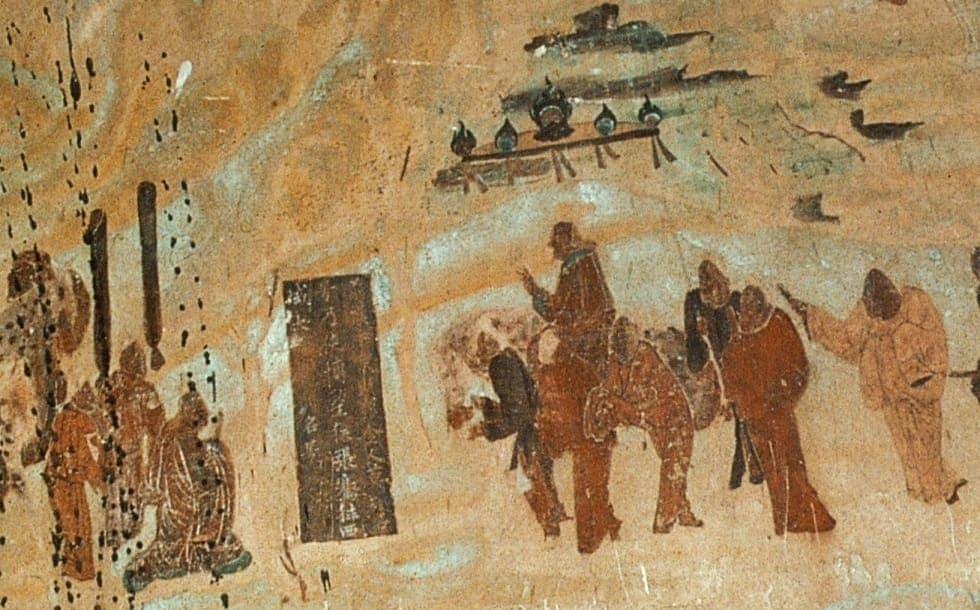
So the honest version is narrower than the legend and, to my mind, better. He did not build a road, and he did not invent the traffic on it. He produced the first reliable description of Central Asia ever written in Chinese, and he convinced an empire to spend money and soldiers going there — which turned informal, invisible, hand-to-hand trade into documented, garrisoned, imperial exchange. Later centuries piled things onto him that are not his: the grapes and alfalfa the Shiji credits to Han envoys generally, and a long later shopping list of pomegranates and walnuts and sesame that appears only in much later books; a Six Dynasties tale that has him sailing up the Yellow River to the Milky Way; and the Dunhuang cave mural at the top of this page, which shows him being sent west to ask the names of two golden Buddha statues — a seventh-century Buddhist claim about the arrival of Buddhism in China, painted seven hundred years after he died, and not history at all. It is also the earliest picture of him that survives. Nothing made in his lifetime shows his face, and nothing ever will. What survives is a man who kept hold of a stick for ten years because it meant he was still an ambassador, and who came home with a continent in his head.