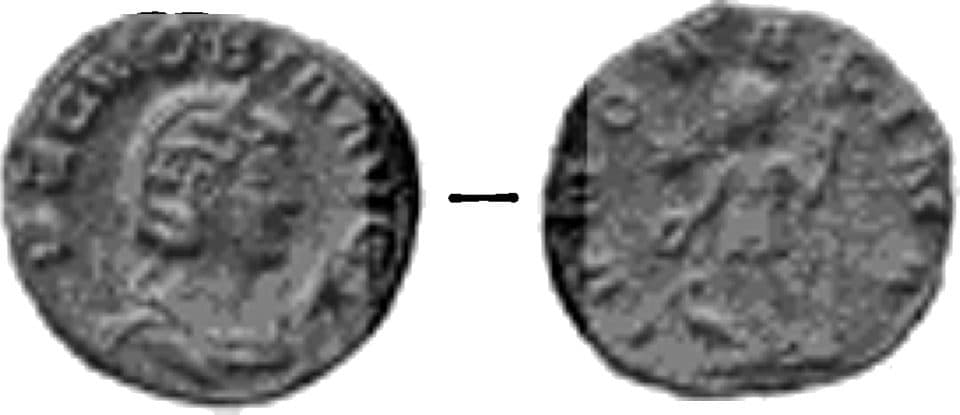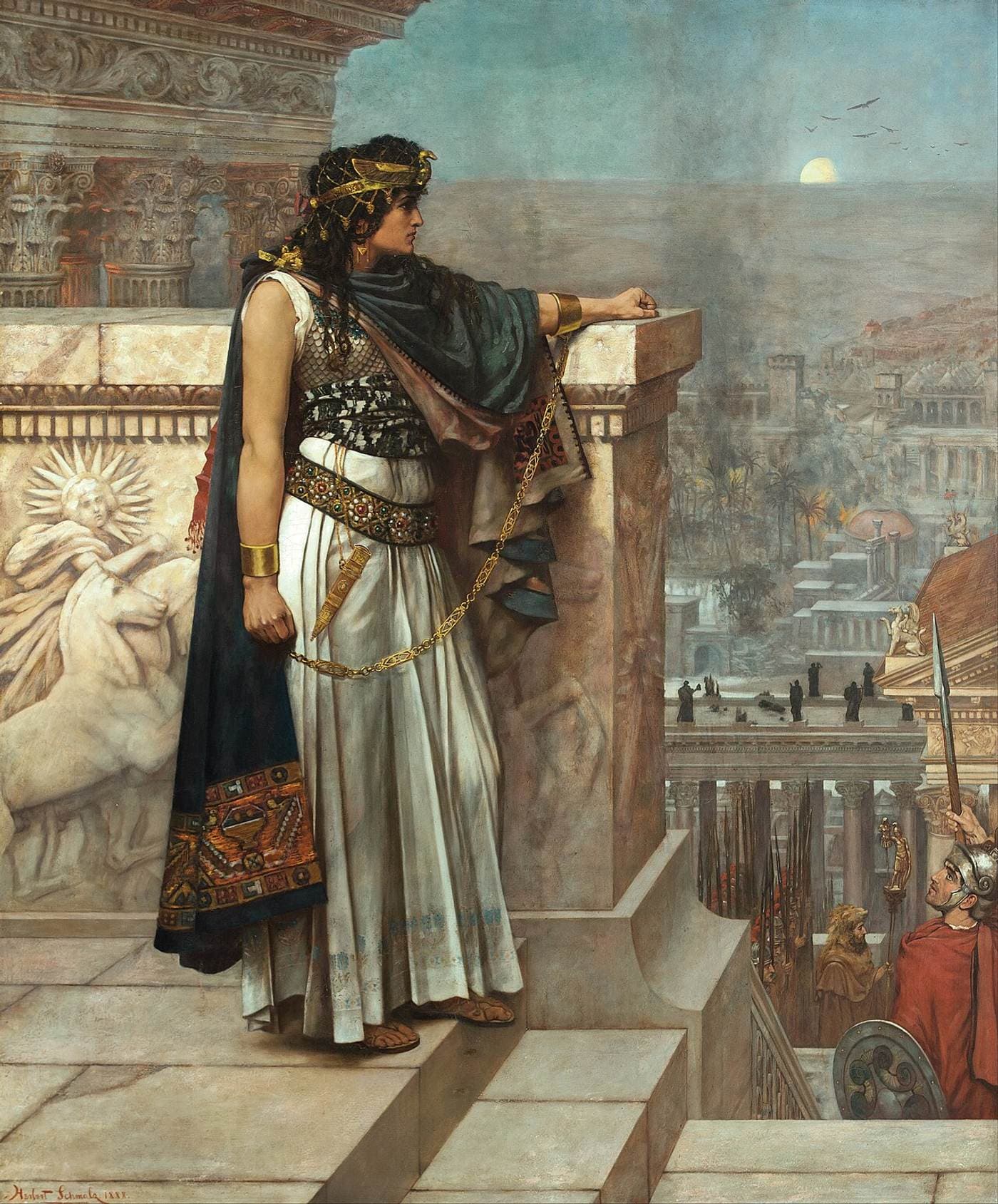
- Born
- c. AD 240Palmyra, Roman Syria · now Tadmur, Homs Governorate, Syria
- Died
- c. AD 274Disputed — last seen in Roman custody after her capture near the Euphrates; the most-repeated later tradition places her final years at Tibur, outside Rome · now If that tradition is correct, Tivoli, Italy — but this is one of four incompatible ancient accounts (see "The Vanishing Queen")
- Known for
- Leading Palmyra's conquest of Roman Egypt and Anatolia, then declaring herself empress against Rome
- People
- Palmyrene — Aramaic-speaking caravan-city aristocracy of Roman Syria, with their own language, gods, and unusually independent civic tradition inside the Roman Empire
- Spouse
- Septimius Odaenathus, ruler of Palmyra — she was his second wife
- Children
- Vaballathus, her son and co-rulerSeptimius Antiochus, a younger son named only in the Historia Augusta — thinly attested
“You demand my surrender as though you were not aware that Cleopatra preferred to die a Queen rather than remain alive, however high her rank”
A purported letter to Aurelian, preserved only in the Historia Augusta (Tyranni Triginta 30) — almost certainly a literary invention written a century after her death, not a genuine document
Milestones
- c. AD 240Born, probably at Palmyra (no source states the year)
- c. AD 255Marries Odaenathus, ruler of Palmyra, as his second wife
- AD 267Odaenathus assassinated; Zenobia becomes regent for her young son Vaballathus
- AD 270A Palmyrene army conquers Roman Egypt
- AD 271Palmyrene forces reach Ankara; Zenobia and Vaballathus claim full imperial titles
- AD 272Defeated by Aurelian and captured fleeing east across the Euphrates
- c. AD 274Displayed in Aurelian's triumph at Rome — the last securely dated event of her life
Early Life
Zenobia was born into the ruling aristocracy of Palmyra, a wealthy caravan city in Roman Syria that grew rich by taxing and guarding the overland trade route linking the Mediterranean world to Persia and, beyond it, the Silk Road. No source records the year of her birth; historians back-calculate roughly 240 AD from how old she seems to have been at the events that follow, which makes it an estimate, not a fact. Around the age of fourteen or fifteen, she became the second wife of Septimius Odaenathus, the most powerful man in the city and, by Roman appointment, its "lord" — a Rome-recognized authority over the whole eastern frontier once he had checked a Persian invasion in the 260s.
Her Palmyrene name, preserved in the city's own Aramaic inscriptions independent of the later Greek and Roman storytelling, was Bat-Zabbai — "daughter of Zabbai." That detail matters, because almost everything else told about her comes from a single, notoriously unreliable source: the Historia Augusta, a late-Roman collection of biographies that modern historians agree invented documents, speeches, and colorful detail wholesale. It is the Historia Augusta that claims Zenobia was descended from Cleopatra and the Ptolemaic queens of Egypt — a claim no earlier or more reliable source repeats, and one nearly every modern historian treats as flattering invention rather than genealogy.
In 267 or 268, Odaenathus and his elder son from an earlier marriage were assassinated. The ancient sources cannot agree on who did it or why — a jealous cousin, a personal feud, even a Roman plot have all been suggested by different late writers, and modern historians consider the question unresolved. What is certain is what happened next: Zenobia, mother of the surviving young heir Vaballathus, stepped into power as his regent, holding the Palmyrene title of qore — sovereign — in her own right.
Mistress of Egypt
By 270, Zenobia's Palmyra was no longer content to be Rome's loyal frontier guardian. That year, a Palmyrene army under her general Septimius Zabdas invaded Roman Egypt and defeated its garrison — a conquest confirmed not just by later historians but by contemporary Egyptian grain-shipment records and coinage that switch to naming Palmyrene authority. Ancient writers put the opposing forces at some 70,000 Palmyrenes against 50,000 Romans; treat that, as with most ancient army counts, as a rough impression of scale rather than a census anyone actually took.
The following year, Palmyrene forces pushed north through Anatolia, reaching as far as Ankara — deep into territory nobody would have predicted a Syrian caravan city's army could hold. Zenobia now controlled, in her son's name, a swath of the eastern Mediterranean stretching from Egypt's grain fields to the Anatolian plateau: on paper still part of the Roman Empire, in practice her own.
Historians still argue about what she intended at this point. Did she plan full independence from Rome from the start, or did a more ambiguous claim to regional authority harden into open rebellion only once the new emperor Aurelian made clear he would not tolerate it? The sources we have were all written by Romans looking backward, which tends to flatten an uncertain, evolving situation into a clean story of rebellion — a caution worth remembering as the story turns to open war.
War with Rome
Late in 271, Zenobia had her son proclaimed with the full imperial titles of Augustus, and — by most reconstructions — took the title Augusta for herself. Whatever legal fiction her court dressed it in, Roman observers, and Aurelian above all, read this as exactly what it was: a declared break from Rome.
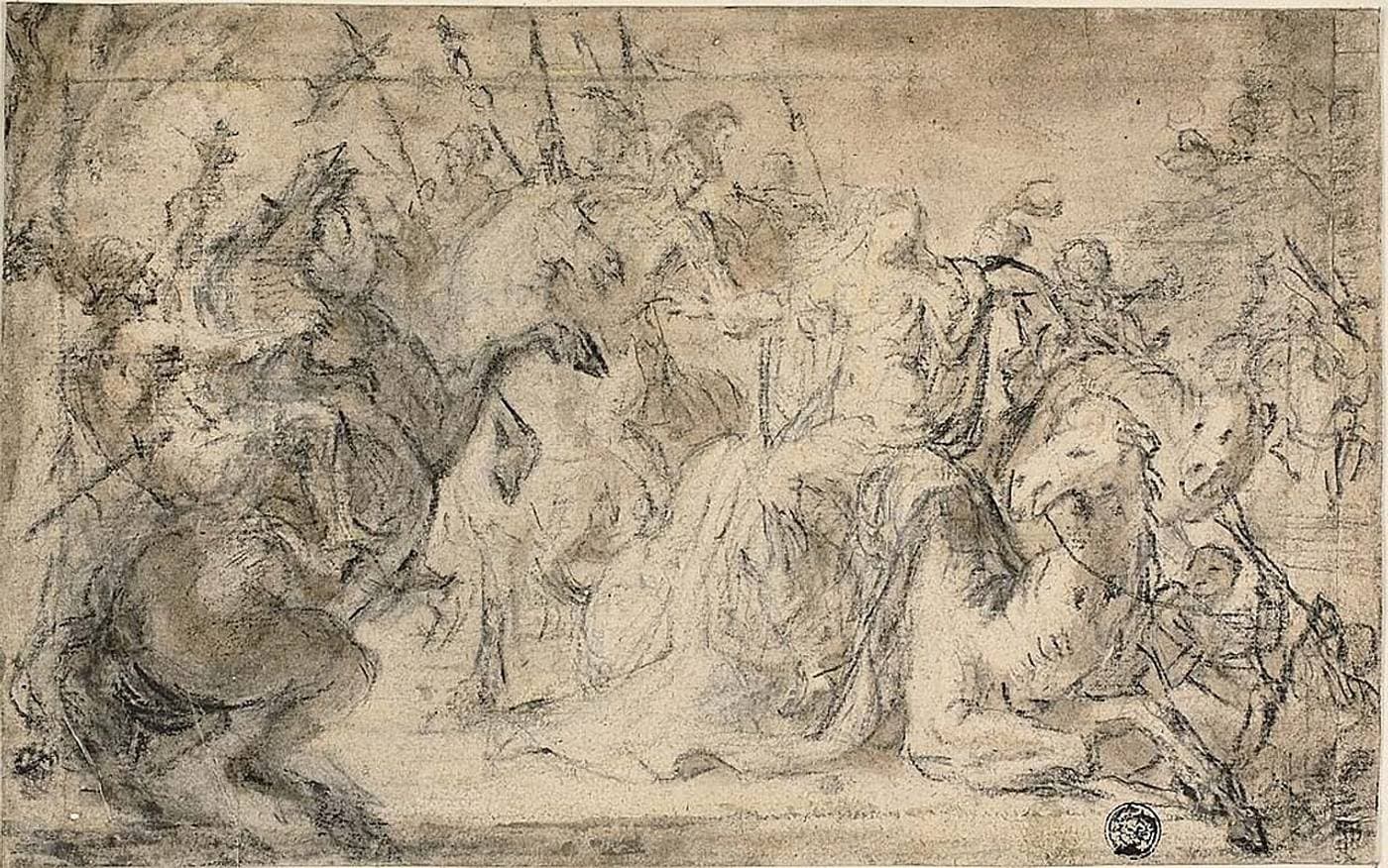
Aurelian marched east in 272. He defeated the Palmyrene army twice, at Immae near Antioch and then at Emesa, and pushed on to besiege Palmyra itself. Zenobia tried to escape east across the Euphrates, reportedly to seek help from Rome's great rival, Sassanid Persia — but Roman cavalry ran her down before she reached the river. Her chief advisor, the Greek philosopher Cassius Longinus — a celebrated teacher of rhetoric, tutor to Vaballathus, and by tradition (though scholars still debate the attribution) the author of the treatise known as On the Sublime — was executed by Aurelian's order, on the charge of having counseled her defiance. Ancient sources say that once in Roman hands, Zenobia herself shifted the blame for the war onto Longinus and her other advisors. Whether that reflects genuine desperation or is itself a hostile source's way of shrinking a real rival sovereign down into a manipulated woman is impossible to know for certain — but it is worth naming as a question, not accepting as plain fact.
The dramatic letters supposedly exchanged between Zenobia and Aurelian during the siege — including her famous line invoking Cleopatra's refusal to be paraded alive — survive only in the Historia Augusta. Virtually no modern historian believes these are real documents; they read as exactly the kind of stirring, quotable invention that book's unknown author specialized in. It is a wonderful line. It is very unlikely she ever said it.
Capture
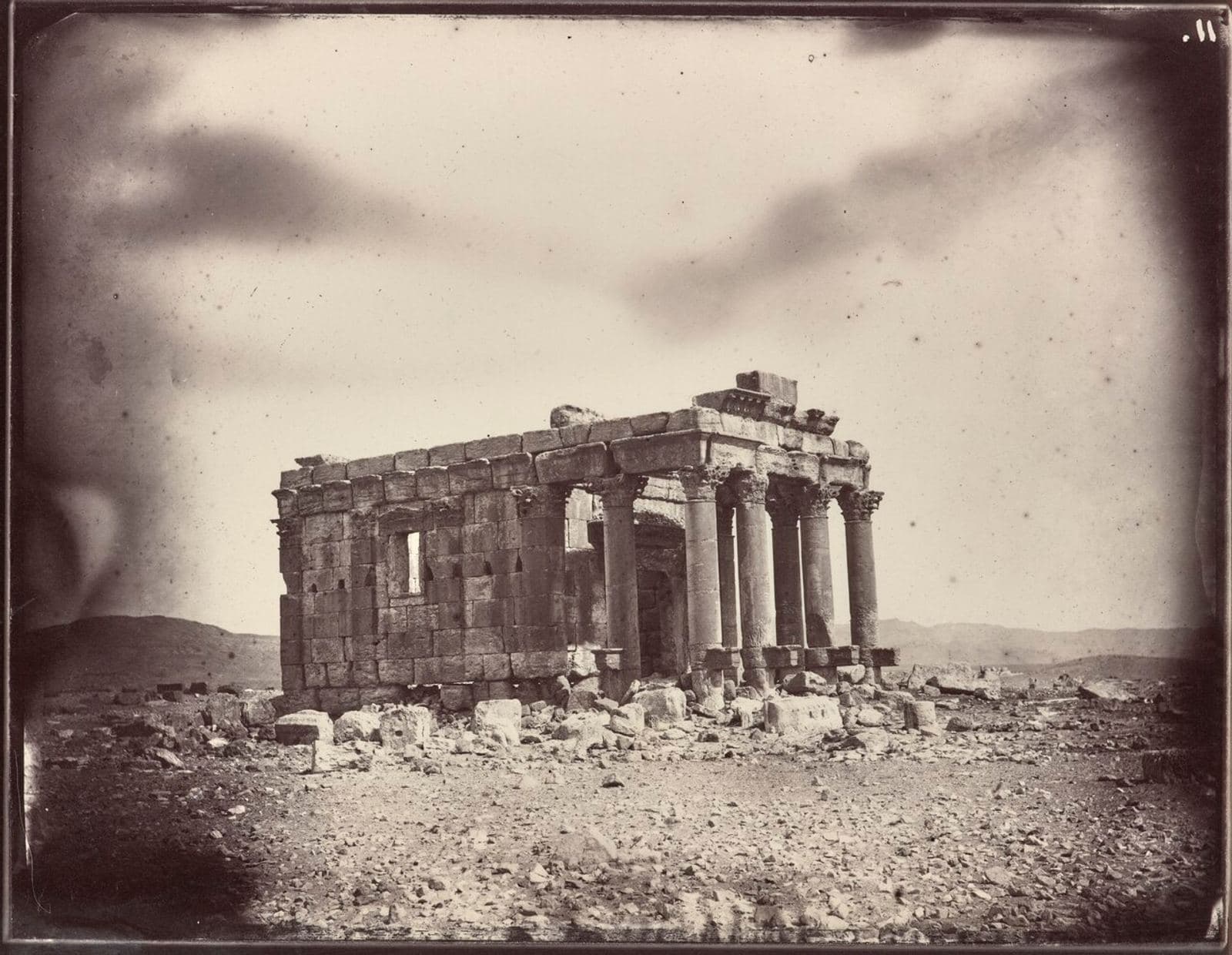
Palmyra fell in 272, and its story does not end cleanly with Zenobia's capture. The following year, after Aurelian had withdrawn, the city rose again — reportedly massacring the Roman garrison he had left behind. Aurelian turned back east a second time, and this time he did not merely defeat Palmyra: he destroyed it. The caravan city that had briefly ruled from Egypt to Anatolia never recovered its former power. Its ruins, photographed by 19th-century travelers and Instagrammed by 21st-century tourists before a different war reached them in the 2010s, are a second, later tragedy layered on top of Zenobia's own.
For Zenobia herself, capture in late 272 is the last event every ancient source can agree on. What happened to her afterward is where the record splits — and that split is the real ending of her story.
The Vanishing Queen
Ancient and Byzantine writers offer at least four different, incompatible endings for Zenobia, and modern historians have never been able to settle which, if any, is correct.
The most-repeated version, found in the Historia Augusta and echoed by the 8th-century Byzantine chronicler Syncellus, says she was displayed — in golden chains, in the most dramatic telling — in Aurelian's triumphal procession through Rome in 274, then pardoned, given a villa at Tibur outside the city, and lived out her life remarried to a Roman senator. A second tradition, from the more skeptical Byzantine historian Zosimus writing three centuries later, says she never reached Rome at all: that she starved herself, or fell ill and died, somewhere on the journey. A third, much less repeated account has her drowning in the Bosporus during transport. A fourth, favored by almost no modern historian, has Aurelian simply executing her — a version that sits awkwardly against Aurelian's well-documented habit of parading defeated rivals alive as proof of his own magnanimity, rather than quietly killing them.
Patricia Southern, whose 2008 biography is the standard modern account, leans toward the villa-at-Tibur tradition as the version most consistent with how Aurelian handled other defeated enemies — but she is explicit that "leans toward" is as far as the evidence allows anyone to go. No source gives a death year. This page's "274" is not a fact; it is the last date anyone can pin her to with confidence — the year of the triumph, whichever of the four endings followed it.
What is not in dispute is the shape of what she achieved and lost: for roughly two years, a woman ruling from a Syrian caravan city in her young son's name held territory stretching from the Nile to central Anatolia, and forced the Roman Empire to fight a real war to take it back. Rome kept the last word, as it kept the sources. Palmyra's own voice — what Zenobia might have said about any of this in her own words — does not survive at all.