- Born
- AD 603Lakamha' (Palenque) · now Palenque archaeological site, Chiapas, Mexico
- Died
- AD 683Lakamha' (Palenque) · now Palenque archaeological site, Chiapas, Mexico
- Known for
- Ruling Palenque for 68 years and building the Temple of the Inscriptions as his own funerary monument
- People
- Classic Maya — one of many rival city-states of the Maya lowlands, ruled by dynasties who recorded their histories in a hieroglyphic script only fully deciphered in the late twentieth century
- Spouse
- Ix Tz'akbu Ajaw, married 626, died 672 — probably (though not certainly) the noblewoman later found in the cinnabar-coated 'Tomb of the Red Queen' next to Pakal's own
- Children
- K'inich Kan Bahlam II, born 635, reigned 684–702K'inich K'an Joy Chitam II, born 644, reigned 702–c. 711Tiwol Chan Mat, born c. 648 — never ruled, but was father of a later Palenque king
Milestones
- AD 603Born at Lakamha' (Palenque), recorded on his own sarcophagus lid by Long Count date
- AD 611Palenque loses a war and its king amid pressure from the rival power Calakmul
- AD 615Accedes to the throne at age twelve, after his mother's own three-year reign
- AD 626Marries Ix Tz'akbu Ajaw
- c. AD 654Rebuilds and expands the Palace, including House E, built for royal accession rites
- AD 675Begins the Temple of the Inscriptions as his own funerary monument
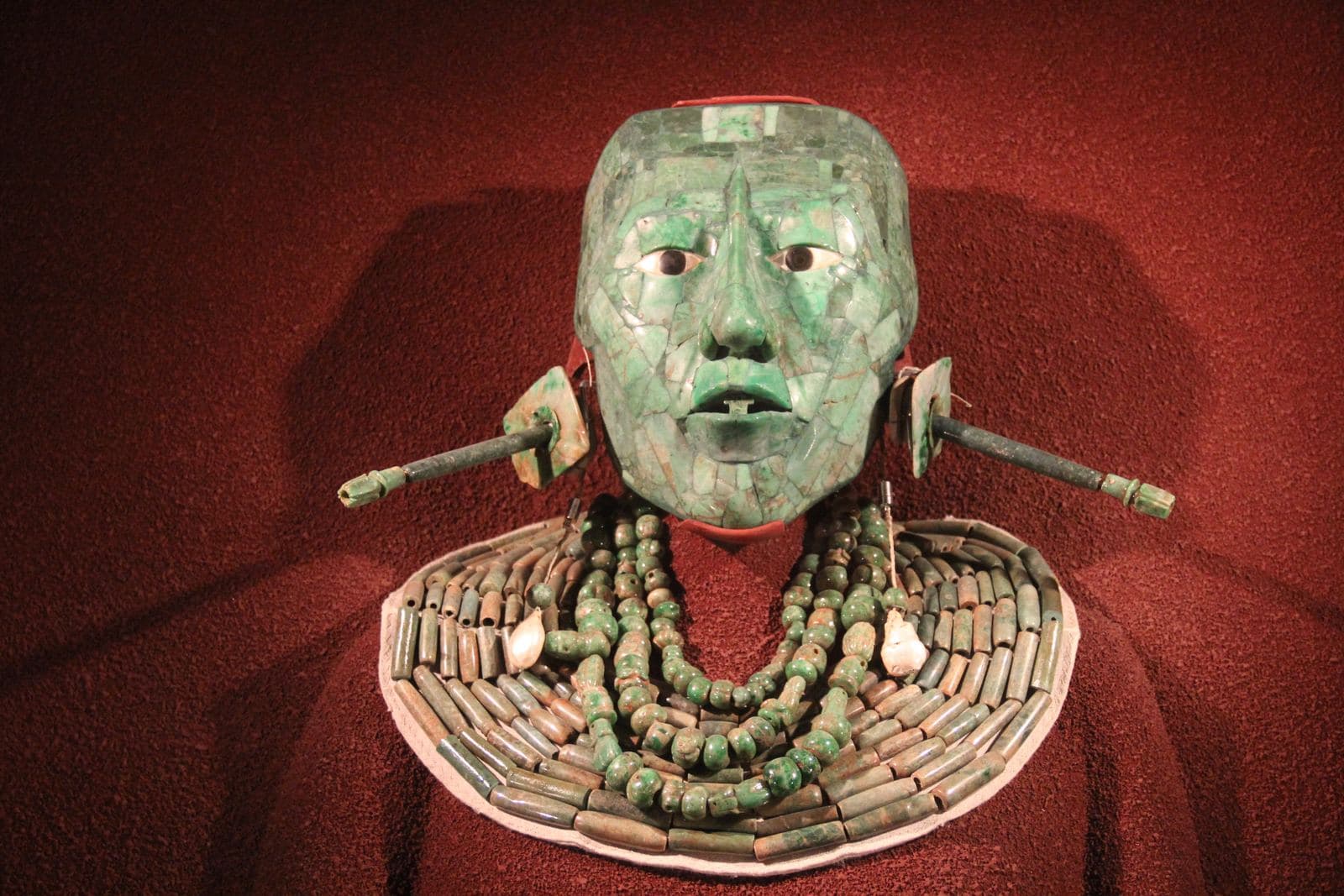
- AD 683Dies at 80 by his own monuments' count; entombed under the Temple of the Inscriptions in a jade mosaic mask
A Boy King
Pakal was born in AD 603 at Lakamha' — "Big Water," the Classic Maya name for the city we call Palenque, in the forested foothills of what is now Chiapas, Mexico. We know the date precisely because Pakal's own scribes carved it, decades later, on the lid of his sarcophagus: a Maya Long Count date that converts, by the correlation almost all Maya epigraphers now use, to March of AD 603.
His childhood fell in a rough decade for his city. Palenque lost a war and lost its king in 611, likely under pressure from Calakmul, the rival superpower of the Maya lowlands that spent much of the 600s trying to break every city allied against it. Instead of collapsing, Palenque did something unusual: Pakal's mother, Lady Sak K'uk', took the throne in her own name and ruled for about three years, until her son turned twelve — the age Palenque's court apparently reckoned a king could take real power. On a date corresponding to July 615, he did.
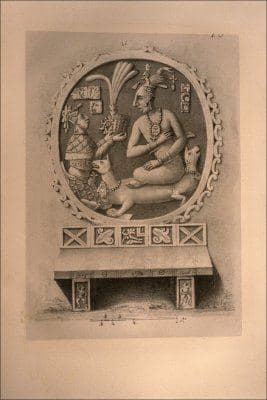
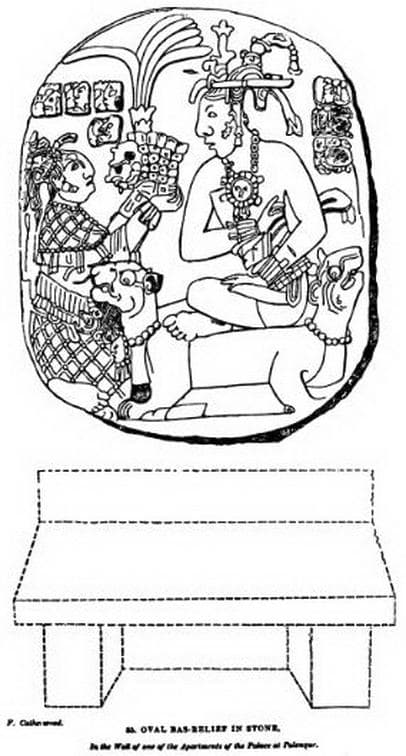
This is where the honest history gets more interesting than the postcard version. Classic Maya kingship ran, by convention, from father to son. Pakal's own path to power ran through his mother instead, and Palenque's inscriptions show real, deliberate effort to make that pedigree bulletproof. Palenque's own Oval Tablet — carved for the room where Pakal's household actually lived — shows the moment itself: Sak K'uk' placing the royal headdress on her son's head, a coronation scene staged inside his own home rather than a temple, as if the family wanted no ambiguity about where his authority came from.
Working out this whole story — that a document scholars once read as naming an entirely separate, otherwise-unknown ruler between Pakal's grandfather and Pakal himself was actually his mother, wearing the name of a mythical creator goddess to strengthen her claim — took Maya epigraphy decades. The broad dynastic sequence was pieced together at the Palenque Round Table conferences starting in 1973, chiefly by Linda Schele working with Peter Mathews and the linguist Floyd Lounsbury; the specific goddess-merger reading was refined later still, principally by David Stuart in the 2000s. It's a case study in how much interpretive work sits underneath even a "settled" royal biography.
Building an Empire in Stone
Pakal reigned for 68 years — one of the longest confidently dated reigns of any king anywhere in the ancient Maya world — and he used the time to rebuild Palenque from a city that had just lost a war into one of the great powers of the Classic Maya lowlands. The clearest evidence is architectural: under Pakal, the Palace — a sprawling complex of courtyards, galleries and a distinctive four-story watchtower that still dominates the site — was expanded again and again, including the construction of House E around the mid-600s, built specifically to stage royal accession rituals like the one shown on the Oval Tablet.
In 626 Pakal married Ix Tz'akbu Ajaw, a noblewoman recorded in Palenque's inscriptions with real prominence of her own; she is very probably — though this identification rests on strong circumstantial grounds rather than an inscription naming her outright — the woman buried with striking cinnabar-red grave goods in what modern archaeologists nicknamed the "Tomb of the Red Queen," discovered in 1994 in a temple next to Pakal's own. Their marriage lasted until her death in 672 and produced at least three sons, two of whom would later rule Palenque themselves.
None of this building program was decoration for its own sake. Every renovated courtyard and every new relief panel did political work, restating Pakal's legitimacy and his family's divine sanction to a court and a rival-city world that had watched Palenque nearly come apart a generation earlier. The Palace as tourists walk through it today is substantially Pakal's Palace — expanded further by his son Kan Bahlam, but built on a plan Pakal set.
The Longest Reign, The Longest Text
Toward the end of his life, around 675, Pakal began the project he is now best known for: the Temple of the Inscriptions, a nine-tiered pyramid built as his own funerary monument, with a temple at the summit and, buried deep inside, the vaulted crypt that would hold his tomb. Its three interior door panels carry the longest continuous hieroglyphic inscription known anywhere in the ancient Maya world — over 600 glyph blocks recording Palenque's dynastic history down through Pakal's own reign, finished and dedicated by his son after Pakal's death.
The scale of the ambition is worth sitting with. This was not a temple built and then, incidentally, used as a tomb — the crypt and the descending stairway down to it were engineered into the pyramid's design from the start, something archaeologists did not fully appreciate about any Maya pyramid anywhere until this one was excavated. It rewrote what historians thought Maya monumental architecture was for.
Death and the Sarcophagus
Pakal died on a date recorded, again, on his own sarcophagus lid: Long Count 9.12.11.5.18, the Calendar Round day 6 Etz'nab 11 Yax, converting to late August of AD 683 — eighty years, by his monuments' own count, after his birth. That death, seventeen years before The Ember Atlas's antiquity cutoff of AD 700, is the best-documented single date in his entire biography: it appears not as a modern scholar's calculation from fragmentary evidence, but carved by his own court onto the lid of the coffin built to hold him.
His tomb sat sealed and untouched for nearly thirteen centuries until the Mexican archaeologist Alberto Ruz Lhuillier, digging down a rubble-choked interior stairway for four years, finally lifted the sarcophagus lid on 15 June 1952 — proving for the first time that a Maya pyramid could be a royal mausoleum, not simply a temple platform. Inside, Pakal's skeleton lay dressed as the Maize God: a jade mosaic mask over his face, jade beads and ornaments covering his body, in a stone sarcophagus so large it had to be carved and lowered into the crypt before the pyramid was finished around it.
The lid itself is carved with one of the most sophisticated single images to survive from the ancient Maya world: a cross-shaped World Tree, a celestial bird at its top, and at its base Pakal himself — shown at the moment of falling into the open jaws of the underworld and, in the same image, rising reborn as the young Maize God, climbing the tree toward the world of the living. It is a death scene and a resurrection scene layered into one carving, following cosmological conventions attested on dozens of other Classic Maya monuments and painted vessels.
The Astronaut Legend
Here is the part of Pakal's story most people have actually heard, and it deserves to be named and corrected directly rather than politely ignored. In 1968 the Swiss writer Erich von Däniken, in his bestseller Chariots of the Gods?, looked at the sarcophagus lid and declared that it showed Pakal seated in a rocket ship — leaning forward over a control panel, flames and smoke pouring from an engine beneath him, proof, he argued, of ancient astronauts visiting Earth.
No Maya archaeologist, epigrapher or art historian takes this reading seriously, and it is worth being specific about why, rather than just asserting that scholars disagree. Von Däniken's reading requires ignoring the World Tree cross-motif that appears on dozens of other Palenque and Maya monuments with no ambiguity about what it means; ignoring the serpent head beneath Pakal, a standard Maya symbol for the entrance to the underworld; and ignoring the glyphic captions carved directly on the lid, which are readable Maya text naming Pakal and recording calendar dates — not abstract instrument-panel symbols. It also requires treating one image in total isolation from the rest of Maya art, rather than as part of a coherent, independently attested visual language for death and rebirth that Maya kings used for centuries before and after Pakal.
The astronaut theory is a textbook case study for historians of pseudoarchaeology precisely because of how it works: it takes a real, dense, meaningful image from a culture most readers know little about, and reinterprets it using a frame — 1960s space-age imagery — that has nothing to do with the culture that made it. It remains widely circulated because it is a fun story, not because it holds up. The sarcophagus lid does not need a spaceship to be remarkable; it is already one of the most sophisticated pieces of religious art the ancient Maya world produced.
Legacy: Sons and the Bones
Pakal was succeeded by two of his sons in turn: K'inich Kan Bahlam II, who finished and dedicated the Temple of the Inscriptions and ruled until 702, and then K'inich K'an Joy Chitam II, whose reign ended badly when Palenque's old rival, the city of Tonina, defeated and apparently captured him around 711. A third son, Tiwol Chan Mat, never ruled but became the father of a later Palenque king. Palenque's dynasty, and its habit of stressing divine female ancestry whenever the succession needed extra legitimacy, continued for generations after Pakal — a pattern his own reign had helped set.
One more debate is worth reporting honestly, because it ran for decades and was never quite as simple as either side made it sound. When Pakal's skeleton was first studied, its teeth showed the kind of light wear usually associated with someone who died around 40 — flatly at odds with the 80 years implied by his birth and death dates. For a long time this was cited as a real, unresolved contradiction between the archaeology and the inscriptions, and it occasionally fed loose talk about whether the skeleton was even really his. More recent, more careful reassessment — collected in a 2006 volume of specialist studies by Vera Tiesler and Andrea Cucina — argues that dental wear is a poor age-marker for a royal individual who ate a soft, low-abrasion elite diet his entire life, and that other skeletal indicators are consistent with a much older individual. That reassessment is now the position most current scholarship favors, tipping the balance back toward the inscribed age of 80 — but skeletal age estimation for very old individuals is inherently imprecise, and it would overstate the case to call this fully and finally settled rather than the current best reading of contested evidence.
What is not in doubt is the scale of what Pakal built and what survived him: a rebuilt city, a dynasty that held power for three more generations, the longest hieroglyphic text the Maya world ever carved, and a tomb that, when it was finally opened after thirteen centuries, changed what archaeologists understood Maya civilization was capable of.