- Born
- c. 600 BCAnshan, Persis · now Fars Province, Iran
- Died
- 530 BCDisputed — ancient authors disagree; Herodotus places it beyond the Jaxartes, fighting the Massagetae · now Conventionally located on the Central Asian steppe near the Syr Darya, along the Uzbekistan–Kazakhstan–Tajikistan border region
- Known for
- Conquering Media, Lydia, and Babylon to found the Achaemenid Persian Empire, and freeing Babylon's displaced peoples to return home
- People
- Persian — of the Teispid royal house of Anshan, the family later generations folded into what they called the Achaemenid dynasty
- Spouse
- Cassandane, a Persian noblewoman and mother of his heir — named only in Greek sources, with no Persian or Babylonian record of her
- Children
- Cambyses II, his heir and successor (r. 530–522 BC)Bardiya, a second son whose fate became central to the succession crisis after Cambyses's deathAtossa, a daughter who later married both Cambyses II and Darius I
“I am Cyrus, king of the world, great king, mighty king, king of Babylon, king of Sumer and Akkad, king of the four quarters of the world, son of Cambyses, great king, king of Anshan”
Cyrus Cylinder, lines 20–21 (British Museum, BM 90920) — his own self-description, inscribed during his reign
Milestones
- c. 600 BCBorn into the Teispid royal house of Anshan, in Persis
- c. 559 BCAccedes as king of Anshan, succeeding his father Cambyses I
- c. 550 BCOverthrows Astyages of Media, absorbing the Median Empire
- c. 547 BCConquers Lydia and defeats its king, Croesus
- 539 BCDefeats Nabonidus at the Battle of Opis and enters Babylon without a fight
- c. 538 BCThe Cyrus Cylinder is composed, recording his policy of returning displaced peoples and gods to their homes
- 530 BCDies campaigning on the empire's northeastern frontier; succeeded by his son Cambyses II
Birth, Legend, and What He Says About Himself
No one knows exactly when Cyrus was born. Modern reference works converge on roughly 600 BC, worked backward from his accession, but published estimates genuinely range across a quarter-century. What filled that early silence, in the centuries after his death, was a dream.
Herodotus tells it this way: King Astyages of Media dreamed his daughter's flood would drown all of Asia, then dreamed a vine growing from her womb would overshadow it. His seers read both as a warning that her coming son would overthrow him, so he ordered the infant killed. The nobleman given the task instead handed the baby to a herdsman to raise as his own; the boy grew up revealing his hidden royalty through a child's game of "king," and the plot unraveled into the grown Cyrus's eventual overthrow of his own grandfather. It is a gripping story, and it is also an old and widely traveled one — the marked infant, exposed or hidden, later revealed as the true king, is the same skeleton behind Moses, Romulus and Remus, and Oedipus. Herodotus himself admits he had heard four different versions of Cyrus's rise and chose the one he found most convincing — which is itself a confession that no settled story existed even a lifetime after Cyrus died. A rival Greek tradition, surviving only in fragments, skips the dream entirely and makes Cyrus a commoner who rose through Median court service.
Cyrus's own account, baked into clay in his own reign, says none of this. He names his father, grandfather, and great-grandfather — three generations of kings of Anshan — and nothing else. No Median grandfather, no herdsman, no dream. Whatever did or didn't happen to him as an infant, his own propaganda is silent on all of it, and stakes his legitimacy on an unbroken Persian royal line instead.
Conquering Media and Lydia
Around 550 BC, Cyrus — king of the Persian vassal kingdom of Anshan — rebelled against his Median overlord, Astyages, and won, absorbing Media into what would become a Persian-led empire. Herodotus dresses the victory up as a revenge plot: a humiliated nobleman defects with his army, Median nobles desert, and Astyages is handed over by his own soldiers. A different Greek tradition describes a harder, less personal war. Babylonian records confirm only the bare outcome — a real war, a broken Median king — without settling which Greek version, if either, is right.
A few years later, around 547 BC, Cyrus turned west and conquered the fabulously wealthy kingdom of Lydia, capturing its king, Croesus, and bringing the Aegean coast of Anatolia under Persian rule for the first time. What happened to Croesus afterward depends entirely on which ancient author is believed. Herodotus's famous version has Cyrus sentence him to burn on a pyre, then relent as the flames rise — too late to stop them, until a sudden rainstorm saves Croesus, who then serves as a trusted advisor for the rest of the story. It is a beautiful scene, and the ancient record disagrees with itself about it: an earlier poet has Croesus trying to kill himself rather than being condemned to die, a painted vase from the period shows him mounting the pyre voluntarily, one historian has him simply pardoned and given a governorship, and a later source claims outright that Cyrus had him executed. What is certain is that Cyrus conquered Croesus's kingdom. What became of the king himself is a story the ancient world could never agree on.
The Fall of Babylon and the Cylinder
In 539 BC, Cyrus defeated the forces of Nabonidus, the last king of Babylon, and entered the city itself without a further fight — his own account says the city's god, Marduk, "made him enter his city Babylon without fighting or battle." Shortly afterward, Cyrus had a clay cylinder buried in the city's foundations, inscribed in Akkadian with his own self-presentation: his royal titles, his lineage, and a claim to have relieved Babylon's people of a forced-labor burden Nabonidus had imposed, and to have returned the images of various gods — gathered into Babylon by his predecessor — to their home sanctuaries.
That cylinder, recovered in 1879 and now in the British Museum, is as close as anything gets to hearing Cyrus speak in his own words, and it is worth being precise about what it actually says. It never mentions Jews, Judah, Jerusalem, or human rights — it is a conventional Mesopotamian royal inscription, a genre with centuries of precedent behind it. The now-famous label "first charter of human rights" dates specifically to 1971, when Iran's government presented a replica to the United Nations as part of a royal anniversary celebration — a twentieth-century political reinterpretation, not an ancient claim, and one that scholars including a former British Museum curator have pushed back on directly.
The biblical books of Ezra and Isaiah separately credit Cyrus with a decree letting the Jewish exiles in Babylon return home and rebuild their Temple, funded from his own treasury — and Isaiah goes so far as to name him, by name, as God's chosen instrument. These are religious texts, composed for a community that experienced his reign as deliverance, not neutral court records, and no independent copy of the decree itself survives. But they fit naturally inside the general policy the Cylinder does attest: a king who, again and again, chose to send conquered peoples and their gods home rather than scatter or suppress them.
Tolerance, Empire, and Administration
By the time Cyrus died, the territory under Persian control ran from the Aegean coast of Anatolia in the west to the edges of Central Asia in the east — one of the largest empires the world had yet seen, built in roughly two decades. The system of provincial governors, or satraps, often credited to him in popular retellings is, on closer historical inspection, mostly the achievement of his successors. Cyrus laid an early, rougher administrative scaffolding, inherited in part from Median and Assyrian precedent; it was his son Cambyses II, and especially his successor Darius I, who turned it into the numbered, standardized system of fixed tribute, royal roads, and inspectors that most people actually picture when they hear the word "satrap."
What does belong to Cyrus specifically, attested independently in both his own inscription and a very different religious tradition, is a consistent policy of leaving conquered peoples' religions alone — a real and notable contrast to harsher models of conquest his contemporaries would have recognized.
Death on the Frontier
Cyrus died in 530 BC campaigning somewhere on the empire's northeastern frontier, against nomadic peoples of the Central Asian steppe — and that is nearly the only part of the story every ancient source agrees on. Herodotus's version, the one most people have heard, has him fighting the Massagetae and their queen, Tomyris: Cyrus baits part of her army into a drunken ambush, causes the death of her son in the process, and is then killed when her main force routs the Persians — after which, in the story's most gruesome detail, Tomyris allegedly has his skull filled with blood. Herodotus himself says plainly that he is choosing this version from among several he had heard, which is as close to a built-in warning label as an ancient historian ever gives.
A different Greek writer, Ctesias, has Cyrus instead fighting a different people entirely, the Derbices, winning the battle, and dying days later from a wound — the Persians victorious, not routed. A third account, from the philosopher Xenophon, has him dying peacefully in bed in old age, delivering a long deathbed speech about the soul — a scene that exists because it serves Xenophon's philosophical point about ideal kingship, not because anyone recorded Cyrus's actual death that way. Herodotus says a steppe queen killed him and kept his skull as a trophy. Ctesias says he died of a wound, victorious, against someone else entirely. Xenophon has him dying peacefully a century removed from pure philosophy. Historians cannot choose between them, and neither can this page.
Tomb and Legacy
What is not in dispute is that Cyrus has a tomb, and it still stands: a plain gabled stone chamber on a stepped plinth at Pasargadae, the city he founded as his capital, now a UNESCO World Heritage Site. When Alexander the Great visited it in 324 BC, two and a half centuries after Cyrus's death, he reportedly found it broken into and robbed — the gold coffin and furnishings gone — and was genuinely troubled enough by the desecration of a predecessor he admired to have it restored. Ancient writers quote an epitaph supposedly carved there — "Passer-by, I am Cyrus, who gave the Persians an empire. Do not grudge me this monument" — but no trace of that inscription survives on the tomb today; it may be a later literary addition rather than Cyrus's own words.
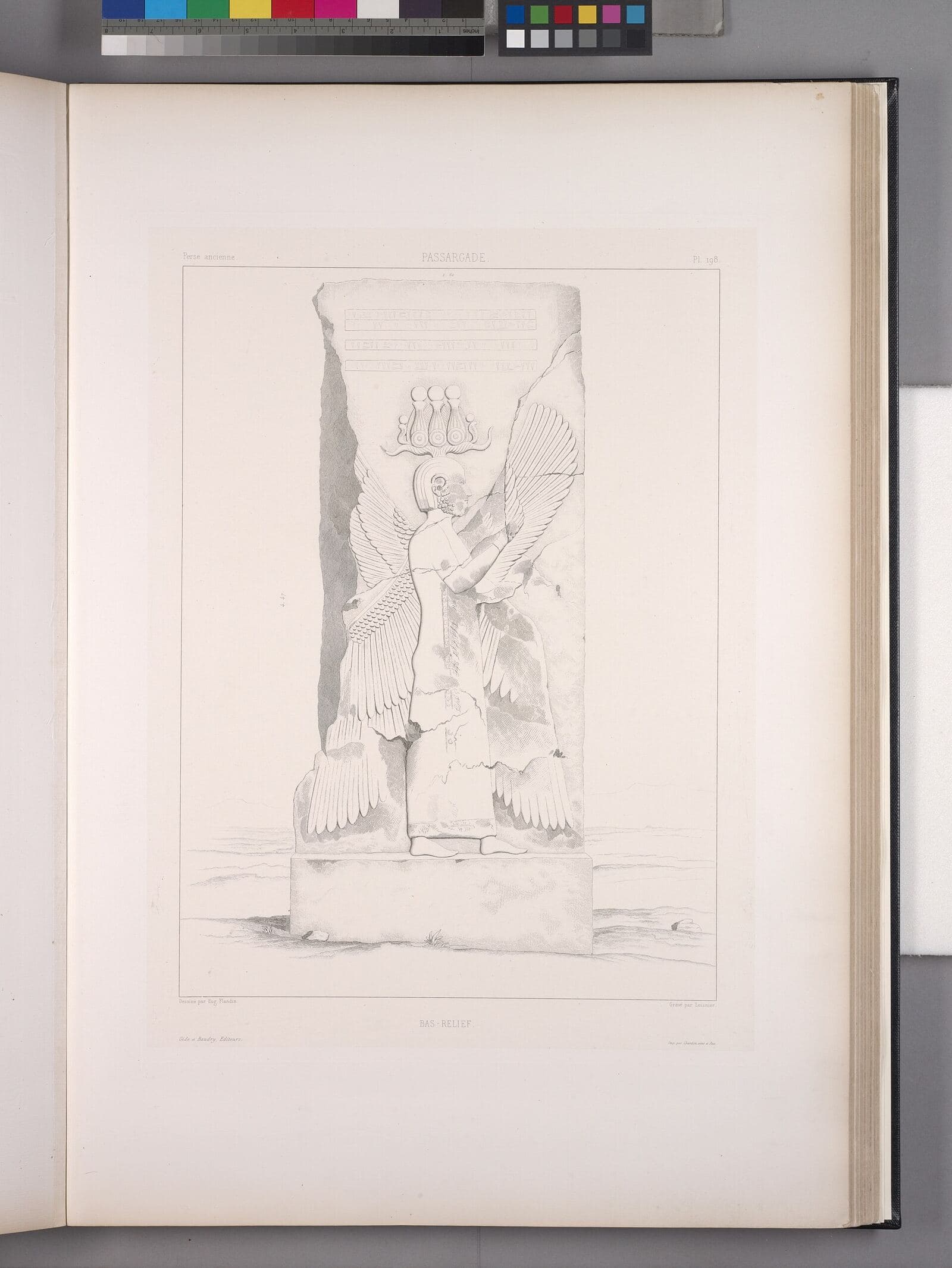
No portrait of Cyrus's face survives from any period. A carved relief at Pasargadae, showing a four-winged figure, was captioned as his likeness for generations — modern scholars now read it as a generic protective spirit, not a royal portrait. The reputation that outlived him traveled, in the end, mostly through a book: Xenophon's Cyropaedia, a philosophical fiction built around Cyrus's name, became a staple of European political writing on ideal kingship, read by Machiavelli and owned by Thomas Jefferson among others. That reputation had a genuine kernel to grow from — the real, inscribed policy of tolerance and restoration on his own cylinder — but the text that did most of the shaping was never meant as history. What is history is simpler and, on its own terms, still extraordinary: in about twenty years, a king from a minor hill kingdom conquered three older and larger empires, and chose, where he could have crushed, to send people home.