- Born
- c. AD 30Iceni territory, Britain · now Norfolk / north Suffolk, England (approximate tribal territory, not a single site)
- Died
- c. AD 61Britain — exact place not recorded by any source · now Unknown; likely eastern England, near the unidentified final battle site
- Known for
- Leading the British revolt of AD 60/61 that burned the Roman towns of Camulodunum, Londinium and Verulamium to the ground
- People
- Iceni — a Brittonic-speaking Celtic tribe of Iron Age eastern Britain, part of the wider Brittonic world drawn into Roman Britain's client-kingdom system
- Spouse
- Prasutagus, client king of the Iceni under Rome — his death around AD 60 and his broken will triggered the revolt
- Children
- Two daughters, unnamed in every surviving source — recorded only as victims of the assault that helped provoke the revolt
“In this battle you must conquer or die. This is a woman's resolve; as for men, they may live and be slaves.”
The close of the battle speech Tacitus composed for her (Annals 14.35, trans. Church & Brodribb) — his own literary construction for the occasion, not a transcript of her actual words
Milestones
- c. AD 30Born, by modern estimate only — no ancient source gives a year
- AD 47The Iceni's first revolt against Rome, over forced disarmament — over a decade before Boudica's own
- c. AD 60Prasutagus dies; his will is ignored, Boudica is flogged, her daughters raped, the kingdom seized
- c. AD 60Leads the revolt — Camulodunum burned, the Ninth Legion's infantry destroyed
- c. AD 61Londinium and Verulamium burned in turn
- c. AD 61Defeated by Suetonius Paulinus at a still-unlocated site on Watling Street
- c. AD 61Dies — by poison per Tacitus, by illness per Cassius Dio; the sources disagree
Early Life & the Client Kingdom
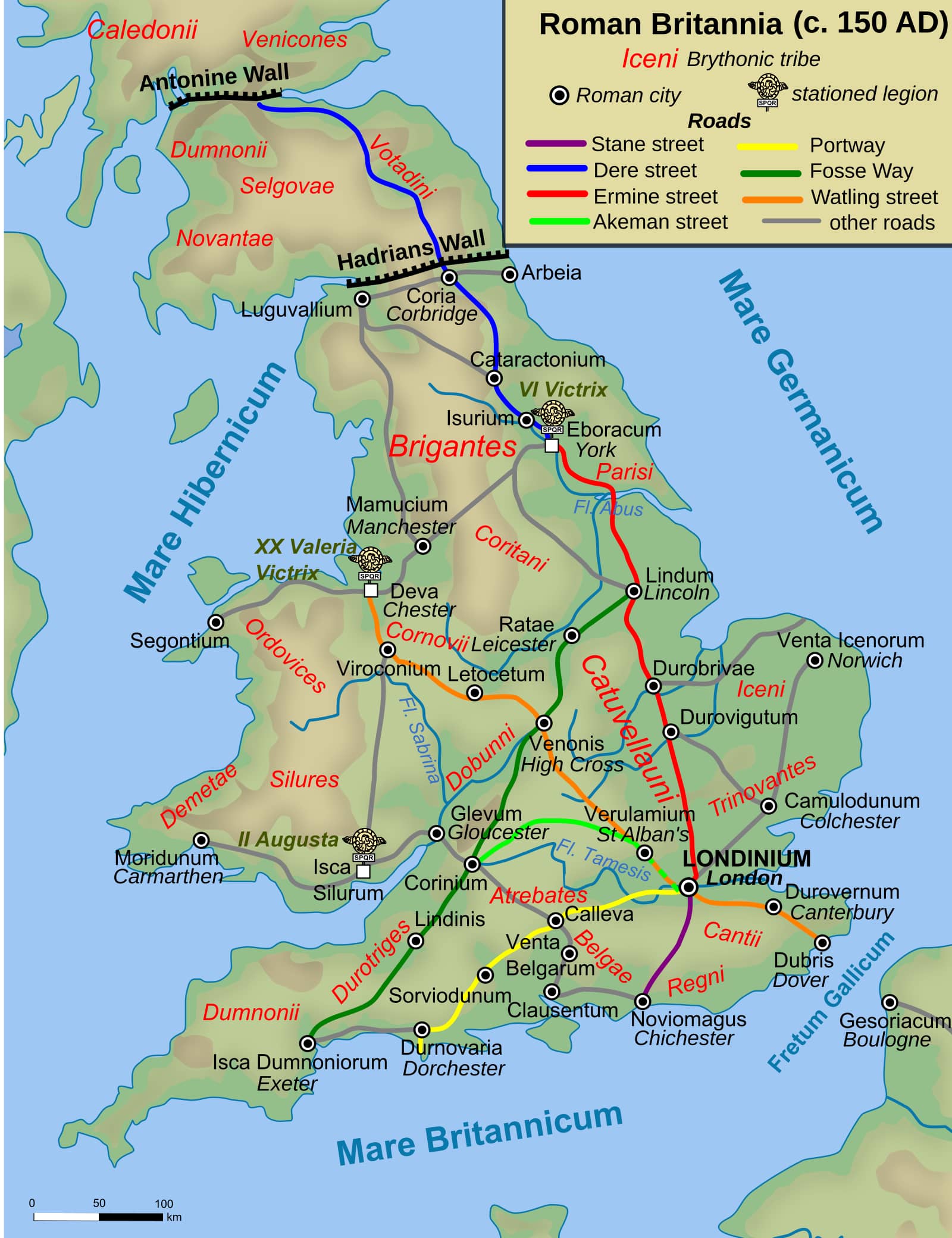
Boudica was queen of the Iceni, a Brittonic Celtic tribe whose lands lay in what is now Norfolk and north Suffolk, in the east of Roman Britain. No ancient source gives her a birth year, a family of origin, or a single detail of her childhood — everything before her marriage to Prasutagus, the Iceni's client king, is simply missing from the record. The AD 30 used on this page's timeline is a modern estimate, not an attested date: it is a guess worked backward from the fact that she was already a married queen with two grown-enough daughters by AD 60/61, and other reconstructions are equally defensible. Say it plainly — we do not know when Boudica was born.
The Iceni were not conquered in the initial Roman invasion of Britain in AD 43. Like several tribes on the edges of the new province, they were left as a nominally independent client kingdom, allied to Rome under their own king. That arrangement was already fraying before Boudica's own revolt: Tacitus records that the Iceni rose once before, in AD 47, when the Roman governor tried to disarm them (Annals 12.31). That uprising was put down, and Prasutagus continued to rule afterward — a reminder that Icenian resentment of Rome had deep roots well before Boudica ever led an army.
Not a word written by an Iceni hand survives. Everything known about Boudica passes to us through Roman writers, decades to over a century after her death.
The Rebellion
Prasutagus died, by most reconstructions, around AD 60. Hoping to protect his family and kingdom, he left a will naming the emperor Nero as co-heir alongside his two daughters — a common enough strategy among client kings currying Roman favour. It failed completely. Tacitus states directly, without euphemism, what followed: Roman officials treated the kingdom as conquered territory outright. The procurator's centurions plundered the Icenian nobility's estates, royal relatives were enslaved, Boudica was flogged, and her two daughters were raped (Annals 14.31). Cassius Dio adds a detail Tacitus never mentions — that Roman moneylenders, including the philosopher Seneca by name, had made large loans to British elites and abruptly called them in around this same time, layering a financial grievance on top of the personal one (Dio 62.2). Both details can be true at once; only Dio records the loans.
The Iceni rose, joined by their neighbours the Trinovantes, who had their own score to settle — Roman veterans at the new colonia of Camulodunum had seized Trinovantian land, and the vast Temple of Claudius built there, funded by forced local contributions, stood as a monument to their subjugation. Camulodunum (modern Colchester) fell first; its last defenders held out in the unfinished temple before it too burned. A detachment of the Ninth Legion, marching to relieve the town under the legate Quintus Petillius Cerialis, was ambushed and its infantry wiped out — only the cavalry escaped.
The governor, Gaius Suetonius Paulinus, was away campaigning against the Druid stronghold on Mona (Anglesey) when word reached him. He raced south to Londinium, judged he lacked the numbers to hold it, and abandoned the town to the rebels, who burned it and killed those who had not fled. Verulamium (modern St Albans) fell next. Tacitus claims close to seventy thousand Roman citizens and allies died across the three towns (Annals 14.33) — a figure modern historians treat with real caution, since no ancient source explains how such a count was even taken. What archaeology does independently confirm is a scorched destruction layer — a band of burnt debris — excavated at all three town sites, corroborating the scale of the burning even where it cannot confirm a death toll.
The Final Battle
Suetonius Paulinus regrouped what forces he had — the Fourteenth Legion, part of the Twentieth, and available auxiliaries, some 10,000 men by Tacitus's count — against a British army the sources describe as vastly larger still (Dio's figure of 230,000 is almost universally regarded by modern historians as wildly inflated). Paulinus chose his ground with care: a narrow defile with forest at his back and open plain ahead, so his outnumbered line could not be encircled.
Where this battle actually happened, no ancient source says, and no one has ever securely identified it. It is often called "the Battle of Watling Street" for the Roman road along which the campaign geography implies it fell, but that is a modern convenience, not an ancient place name. Historians and archaeologists have proposed several candidate sites over the last century — Mancetter in Warwickshire and Church Stowe in Northamptonshire are among the most argued-for — but there is no scholarly consensus, and no battlefield archaeology has confirmed any of them. Any location shown for this battle on an Ember Atlas map is a best-guess marker, not a confirmed spot.
Tacitus's account has the terrain doing the work: the defile funnelled the British charge into the disciplined Roman line, which broke it with volleys of javelins and then a wedge advance. The British were said to have ringed their own rear with wagons so families could watch the expected victory — and when the battle turned, those wagons blocked their own retreat, turning a defeat into a slaughter. Tacitus's numbers — roughly 80,000 British dead against 400 Roman — read, like the town-sack figures, as rhetorically shaped rather than counted, a pattern common to Roman battle narratives contrasting a crushed enemy against minimal Roman cost.
Death & Legacy
What happened to Boudica after the defeat is one of the clearest disagreements in the whole record, and it deserves to be stated as a disagreement rather than resolved into false certainty. Tacitus says she took poison, ending her own life rather than face capture (Annals 14.37). Cassius Dio says she fell ill and died, and was given a costly burial by her people (62.12) — no poison, no suicide, a different story entirely. Modern historians split on which to trust: some favour Tacitus as earlier and closer to informed Roman military circles; others point out that a defiant last-stand suicide is exactly the kind of ending Roman writers liked to give a defeated enemy leader, which should make us cautious rather than credulous about it. No source says where she died, and no burial site has ever been identified — the popular modern story that she lies under a railway platform at London's King's Cross is a 20th-century urban legend with no ancient or archaeological basis at all.
The aftermath is better attested. The procurator Catus Decianus, whose greed Tacitus blames in part for provoking the whole revolt, fled to Gaul. A new procurator, Gaius Julius Alpinus Classicianus, pushed for conciliation over further reprisal, and his complaints helped bring about Paulinus's recall — Classicianus's own funerary inscription survives today, broken and reassembled, in the British Museum, real epigraphic proof this aftermath happened.
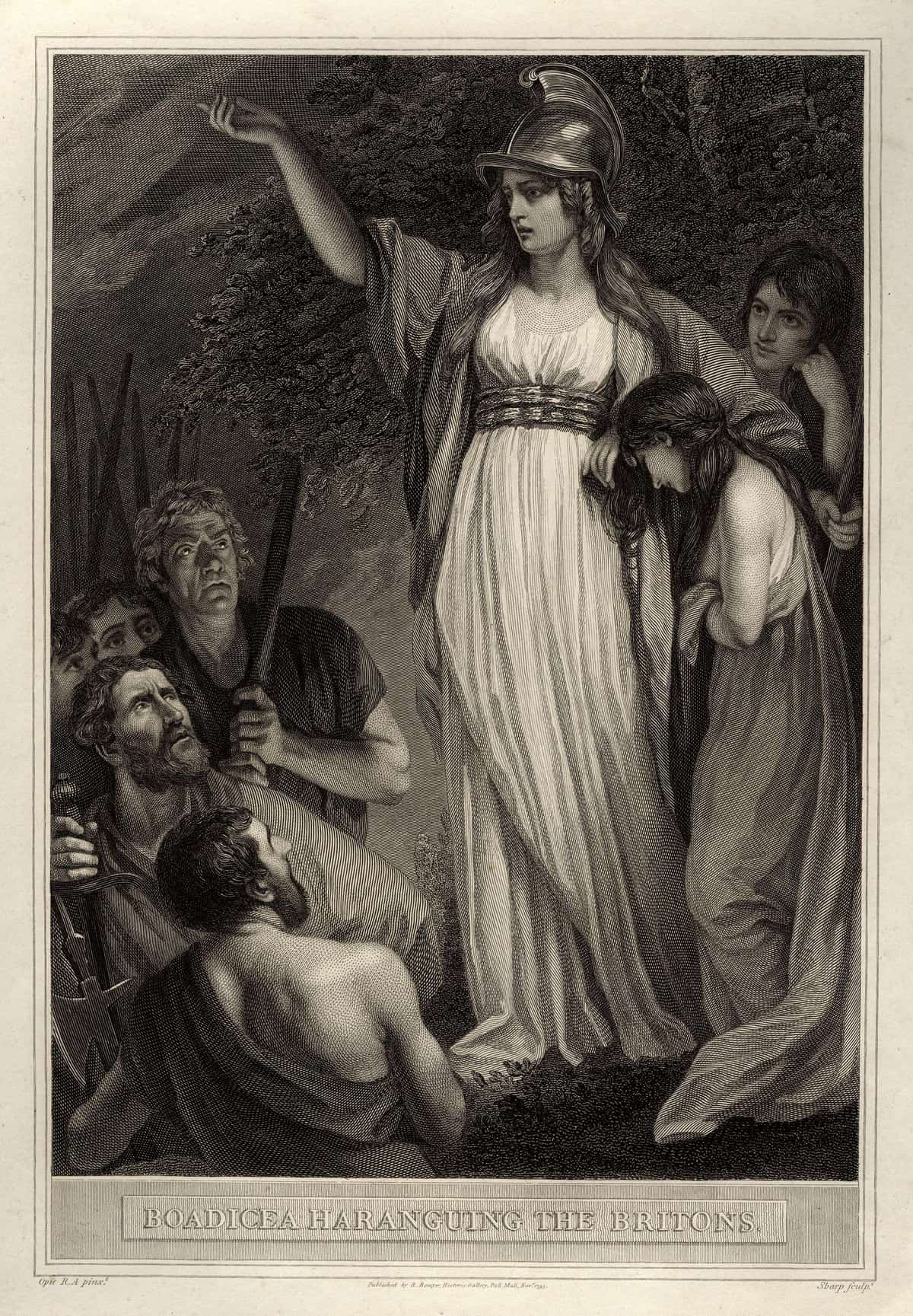
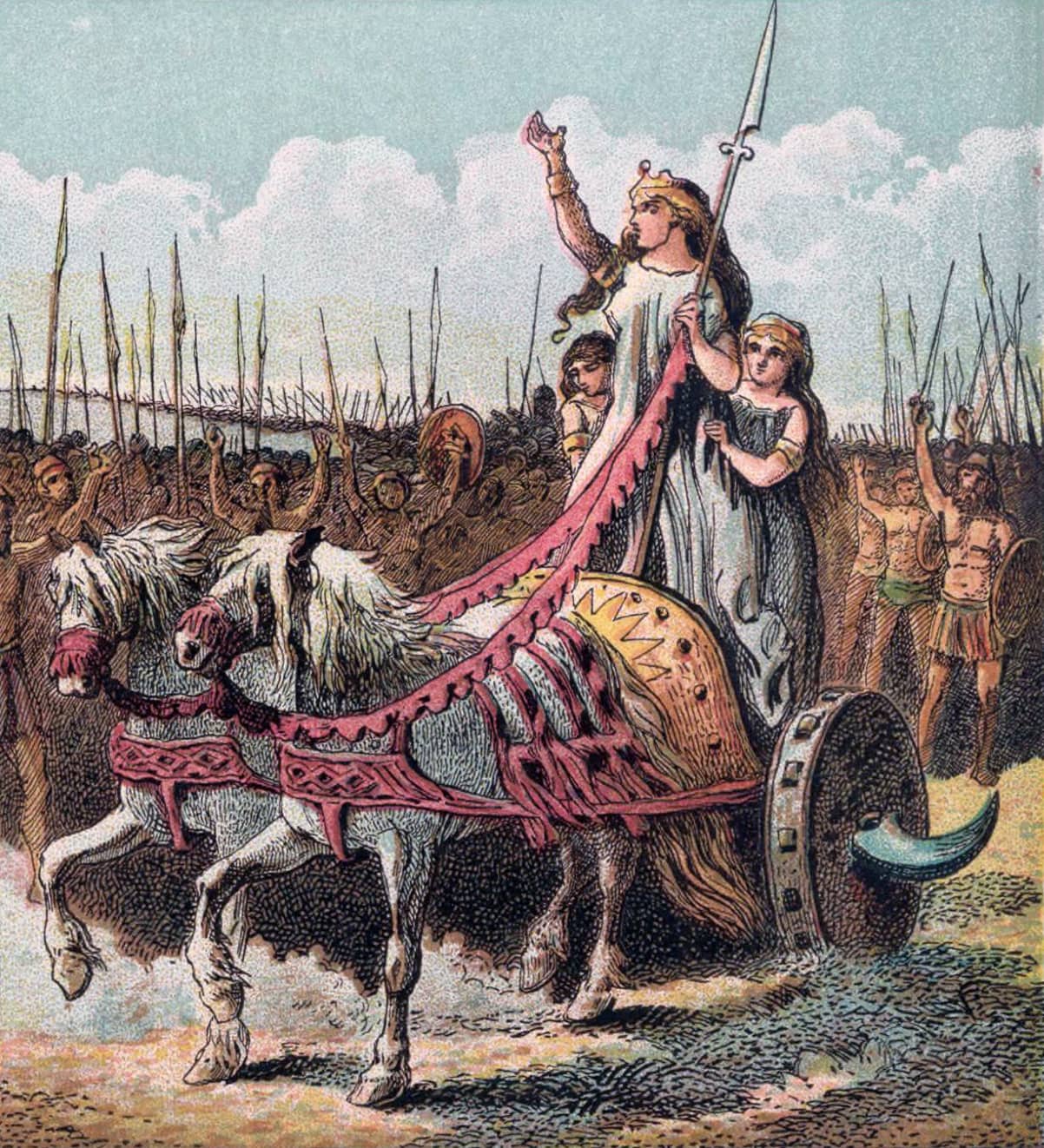
Boudica then largely disappears from English memory for well over a thousand years, resurfacing only once Tacitus's text was rediscovered in print in the 16th century. The Victorians made her their own: Thomas Thornycroft's bronze Boadicea and Her Daughters, worked on from 1856 until his death in 1885 and finally cast and erected by Westminster Bridge in 1902, is the image most people now picture — and it is pure invention, not record. No contemporary likeness of Boudica has ever existed for Thornycroft, or anyone, to have worked from. Even the statue's famous scythed chariot wheels are a myth with no ancient basis at all — no description of British war chariots, including Julius Caesar's own eyewitness account a century earlier, mentions blades on the wheels; the idea appears to be a later antiquarian confusion with Persian chariots, cast in bronze as if it were fact. Every image on this page — an 18th-century painting, a 19th-century engraving — is a later imagining, clearly dated as such. No ancient portrait, coin, or likeness of Boudica has ever been found.