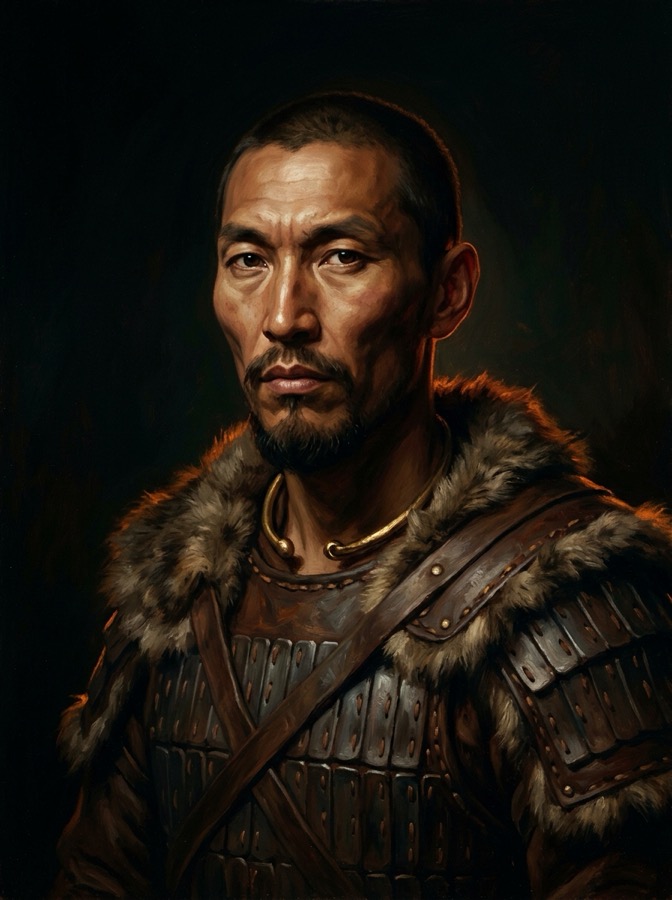
Attila the Hun fought two wars in the Roman Balkans. In AD 441–443, ruling jointly with his brother Bleda, he broke the Danube frontier and took Sirmium, Viminacium and Naissus. In 447, now sole king, he defeated a Roman field army at the river Utus, and a contemporary monk wrote that the Huns took «more than a hundred cities». But he never attacked Constantinople, whose earthquake-shattered walls had been rebuilt in about sixty days, according to the inscription still on them. Peace cost the Eastern Roman Empire 6,000 pounds of gold up front and a yearly tribute of 2,100 pounds.
The Huns arrived in Europe as a rumor — mounted archers from the steppe who broke the Goths and set half the barbarian world moving toward Rome's borders. By the 430s they had become something new: an empire of their own on the Hungarian plain, taking tribute from Constantinople like a protection racket with a cavalry arm. Attila and his brother Bleda inherited that empire in 434. Attila made it a superpower.
The wars on this map were not mindless destruction. Every siege had a point: to prove that no wall could keep him out, and so to make emperors pay him not to come. The proof was thorough. Sirmium, where emperors had reigned — taken. Viminacium, the legions' base — erased so completely that archaeologists found its destruction layer. Naissus, Constantine's birthplace — stormed with siege towers the Romans didn't believe steppe nomads could build.
What stopped him wasn't an army; the armies lost. It was masonry and morale. When the earthquake of January 447 threw down Constantinople's towers with Attila already on the march, the city rebuilt its triple wall in about sixty days — with chariot-racing fan clubs as the labor force. Attila never attacked them; no source even puts him in sight of them. He would die six years later on his wedding night, and the empire he built barely outlived him. The walls he never tested stood for another thousand years.
That's this map's story, and it's why there is no terrain to fly over here. Attila's obstacles were never mountains. They were walls — and one held.
«100+ CITIES» TAKEN · 6,000 LB OF GOLD · THE WALLS: HELD
PROLOGUE — THE FIRST WAR · AD 441–443
Attila and his brother Bleda break the Danube frontier.
1 · Margus (near Požarevac, Serbia) · AD 441
The Grave-Robbing Bishop
Well-attested. This event is solidly documented in the sources.
The war starts at a market fair. Margus, a border town where the Morava meets the Danube, hosted the treaty market where Romans and Huns traded. Then the Huns brought a charge: the bishop of Margus had crossed the river and plundered their royal graves.
Rome refused to hand him over. So the bishop cut his own deal — he slipped out, met the Huns, and opened his city's gates to them. Margus fell without a siege, and the Danube frontier fell open behind it.
SOURCE CHECK — The accusation and the betrayal are in Priscus (fr. 6), our best contemporary source. Whether the bishop actually robbed the graves, no source settles.
2 · Viminacium (Kostolac, Serbia) · AD 441
A Legion's Base, Erased
Well-attested. This event is solidly documented in the sources.
Viminacium was the military capital of the province — a legionary fortress city of tens of thousands, the anchor of the middle Danube. The Huns destroyed it.
This one isn't just in the chronicles: archaeologists digging the site have found the destruction layer. The city was later rebuilt from nothing by Justinian, a century on.
3 · Singidunum (Belgrade, Serbia) · AD 441
The Fortress at the Confluence
Well-attested. This event is solidly documented in the sources.
Where the Sava meets the Danube stood Singidunum — the future Belgrade. It was captured and sacked as the Huns rolled the frontier up westward, one river fortress at a time.
4 · Sirmium (Sremska Mitrovica, Serbia) · AD 441–442
An Imperial Capital Falls
Well-attested. This event is solidly documented in the sources.
Sirmium was no border town. Emperors had ruled the Roman world from here — it had been one of the four capitals of the empire. Now it belonged to Attila and Bleda.
Taking it announced what kind of war this was: not a raid for plunder, but a power that could swallow the cities emperors were made in.
5 · Ratiaria (Archar, Bulgaria) · AD 443
The Fleet and the Forges
Well-attested. This event is solidly documented in the sources.
Ratiaria was the Danube fleet's home port and one of the empire's arms factories — the place that built the weapons meant to stop armies like this one.
The Huns sacked it. The frontier's shield and its armory went down together, and the road south into the Balkans lay open.
6 · Naissus (Niš, Serbia) · AD 441–443
The Siege of Naissus
Well-attested. This event is solidly documented in the sources.
Constantine the Great was born here. Priscus made it his great set-piece: the Huns — supposedly wild horsemen — arrived with battering rams and rolling siege towers, machines the Romans thought barbarians couldn't build, and took the city by storm.
Years later a Roman embassy passed through on its way to Attila's court. They had to camp outside the city, upstream — the riverbank, Priscus says, was still covered with the bones of the slain.
SOURCE CHECK — Naissus fell in Attila's first Balkan war, 441–443; a scholarly minority dates the siege to 447. The siege itself is as well-attested as the 5th century gets.
7 · Serdica (Sofia, Bulgaria) · AD 443
Still in Ruins Six Years Later
Well-attested. This event is solidly documented in the sources.
Serdica sat on the great military highway to Constantinople. The Huns sacked it on their way east.
We know how thorough they were because of a travel diary: when Priscus's embassy stopped here in 449 — six years on — the city was still wrecked, and the diplomats dined in the ruins.
8 · Philippopolis (Plovdiv, Bulgaria) · AD 443
Down the Military Highway
Probable. The sources support this, with some room for doubt.
Philip of Macedon's old city, the next great stop on the highway. The sources for this war name city after city along this road, and Philippopolis almost certainly joined the list — though the record here is thinner than for the Danube fortresses.
9 · Arcadiopolis (Lüleburgaz, Türkiye) · AD 443
Within Reach of the Capital
Probable. The sources support this, with some room for doubt.
The easternmost city the sources name in the first war — just days from Constantinople itself. The empire bought peace with gold, and the Huns rode home richer.
It was a rehearsal. Four years later, Attila — now sole king after his brother Bleda's convenient death — came back down this road.
THE 447 CAMPAIGN · AD 447
Attila alone, against the walls of Constantinople.
10 · Battle of the Utus (the river Vit, Bulgaria) · AD 447
The Field Army Breaks
Well-attested. This event is solidly documented in the sources.
Rome's Balkan field army met Attila head-on by the river Utus. Its commander, Arnegisclus, had his horse killed under him and kept fighting on foot until he died. The army was defeated — the Huns reportedly bled for it, but after the Utus there was no Roman force left in the Balkans that could face them in the open.
SOURCE CHECK — We know the river, not the field. This pin marks the Vit valley — no one has ever located the battlefield.
11 · Marcianople (Devnya, Bulgaria) · AD 447
The Hundred Cities
Well-attested. This event is solidly documented in the sources.
The great city of the eastern Balkans, stormed and destroyed after the Utus. A contemporary monk wrote that in this one campaign the Huns took «more than a hundred cities» — and then named almost none of them. Marcianople is one of the few we can pin.
SOURCE CHECK — The «hundred cities» line is Callinicus, writing within living memory. The number is rhetoric; the scale of destruction isn't.
12 · Constantinople (Istanbul, Türkiye) · Late January – spring, AD 447
Sixty Days to Rebuild a Wall
Well-attested. This event is solidly documented in the sources.
In late January 447 — the year of Attila's great invasion; the historian Christopher Kelly thinks the Huns had already crossed the Danube — an earthquake threw down stretches of Constantinople's famous Theodosian Walls, including fifty-seven towers. The greatest fortification on earth was suddenly open, in the same year the deadliest army on earth was loose in the Balkans.
The city's answer: the prefect Constantinus drafted the Hippodrome's chariot-racing fan clubs — the Blues and the Greens; Byzantine tradition says some sixteen thousand brawling partisans — and set them rebuilding in rival crews. In about sixty days the walls stood again. A Latin inscription still on the walls brags that Pallas Athena herself could scarcely have built so strong a citadel so fast; the Greek lines beside it give the count — sixty days.
He never attacked. No source puts Attila at the walls — what is attested is a breach repaired in time and a city the Huns never assaulted. Historians infer the rest: that the finished walls are why. No siege, no battle. The greatest what-if of the fifth century ends with an army that went elsewhere.
SOURCE CHECK — Earthquake, fifty-seven towers and the rebuild are chronicle-plus-inscription attested. «Sixty days» is the builders' own boast (the chronicle says three months). The picture of Attila before the walls is an artist's impression: no source places him there. What's attested is that he never attacked.
13 · Thracian Chersonese (Gallipoli peninsula, Türkiye) · AD 447
The Last Battle, and the Bill
Well-attested. This event is solidly documented in the sources.
Leaving Constantinople unattacked, Attila's army pushed onto the Gallipoli peninsula and crushed the last Roman force of the campaign there. That battle, not any siege, actually ended the war.
Then came the peace the diplomat Anatolius negotiated: six thousand pounds of gold immediately, the yearly tribute tripled to twenty-one hundred, and twelve gold coins ransom for every Roman prisoner who had escaped. Painful — but Constantinople could afford it. The humiliation cut deeper than the cost.
SOURCE CHECK — The treaty terms are Priscus, rock-solid; scholars still argue over the exact year of the treaty. The tale that senators sold their wives' jewelry is hostile rhetoric — color, not accounting.
14 · Thermopylae (Thermopylae, Greece) · AD 447
As Far South as the Fire Reached
Well-attested. This event is solidly documented in the sources.
Hun raiding parties pushed south until they reached Thermopylae — the pass of the Three Hundred, a thousand years after Leonidas. This is the high-water mark of the 447 campaign, the furthest the burning spread.
Attila rode home the richest man in Europe. Five years later he would try the other half of the Roman world — Italy. That's Act 2.